

Patients often wonder about the specific logic behind neurotoxin dosing, as the numbers can seem arbitrary compared to other medical treatments. At Dr. K Miami Plastic Surgery, we emphasize that Botox functions differently than standard liquid medications, focusing on selective inhibition of nerve signals to specific muscle fibers. Understanding these technicalities helps clarify why your plan might differ from someone else’s.
The difference between milliliters and units
Botox is a biological product measured by its potency rather than by total liquid volume. While a syringe contains a specific quantity of fluid, the “units” describe the binding capacity and strength of the active protein, meaning a smaller volume can hold more units depending on the concentration used during reconstitution.
Why dosage varies by individual anatomy
Every face possesses a unique map of muscle density and skin elasticity that dictates how the product spreads and functions. A person with small, delicate muscles requires a lighter touch to maintain expression, whereas someone with thick, muscular activity might need more to achieve a smooth finish.
The mechanism of action on facial muscles
Once the product is placed into the target muscle, it interrupts the signaling process that triggers contraction. By blocking these impulses, we allow the skin surface to relax and flatten, taking the tension off existing creases and preventing the depth of new lines from worsening over time.
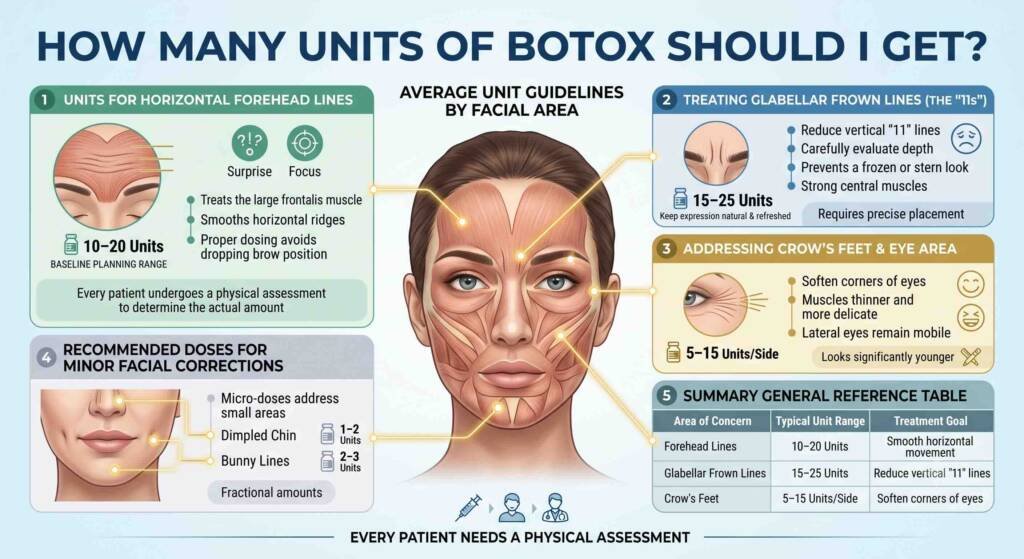
Average unit guidelines by facial area
When you ask, “How Many Units of Botox Should I Get,” it is common to look for a definitive chart to manage your financial and physical expectations. While ranges are helpful for baseline planning, every patient undergoes a physical assessment to determine the actual amount needed for their specific concerns. The following table provides a general reference for common treatment zones.
Units for horizontal forehead lines
Forehead treatment focuses on the large frontalis muscle which controls our brow elevation. Proper dosing avoids dropping the brow position while successfully softening the horizontal ridges that often appear during surprise or focus.
Treating glabellar lines between the brows
| Area of Concern | Typical Unit Range | Treatment Goal |
|---|---|---|
| Forehead Lines | 10–20 Units | Smooth horizontal movement |
| Glabellar Frown Lines | 15–25 Units | Reduce vertical “11” lines |
| Crow’s Feet | 5–15 Units/Side | Soften corners of eyes |
These central muscles are often the strongest in the face, requiring precise placement to prevent a frozen or stern look. We carefully evaluate the depth of these folds to ensure the final result keeps your expression natural and refreshed.
Addressing crow’s feet and eye area concerns
These fine lines radiate from the orbital muscles, which are thinner and more delicate than the central brow muscles. We use specific techniques to address these areas, ensuring that the lateral eyes remain mobile while looking significantly younger.
Recommended doses for minor facial corrections
Beyond larger muscle groups, we frequently address small areas like a dimpled chin or bunny lines on the nose with fractional amounts. These micro-doses deliver significant refinement in facial balance without the risks associated with higher volume placement.
Factors influencing your total unit count
Once you arrive for an aesthetic transformation, we evaluate several variables to finalize your plan. It is a misconception that more units always equate to better results, as the goal is functionality and movement, not just complete immobility.
Muscle mass and strength in the target area
Men often require higher unit counts simply due to having larger, more robust muscle groups. We assess the physical strength of your facial fibers during the initial consultation to ensure the neurotoxin is effectively contained.
Personal aesthetic goals and desired movement
Communication is the most critical factor here because some patients prefer a completely smooth forehead, while others want to retain a subtle amount of natural expression. Sharing your goals early ensures we don’t accidentally over-treat your features.
Previous treatment history and muscle fatigue
Patients who have received consistent treatments over several years often notice their muscles weaken safely over time. This frequently leads to a trend where returning patients need fewer units to maintain the same strikingly smooth results achieved in previous sessions.
Biological differences in neurotoxin metabolism
Some individuals metabolize neurotoxins faster than others, which is a strictly biological reality rather than a reflection of product quality. If your results typically don’t last as long as expected, we often adjust your initial approach with a modified dosing strategy.
The importance of a professional consultation
Generic charts serve as a helpful starting point, but they should never dictate the final clinical plan. A professional consultation at Dr. K Miami Plastic Surgery centers on the art of balancing your physical reality with your expectations through a personalized treatment plan.
Why generic charts provide only estimates
Estimates are inherently flawed because they cannot account for your skin thickness or the specific depth of your wrinkles. Relying on average numbers often results in inconsistent outcomes because it ignores the unique topography of your face.
Physical assessment of expressive facial movement
We observe your face in motion, asking you to frown, smile, and raise your brows to see exactly how your muscles fire. This active mapping process allows us to place units exactly where they will have the most impact on your baseline concerns.
Customizing the dose for a natural appearance
Achieving a natural look involves understanding where to leave movement untouched. We customize the distribution of units to ensure that areas around the eyes specifically remain friendly and engaging rather than appearing fixed or surprised.
Balancing facial symmetry during the mapping process
Most people have slight natural asymmetry, and our injectors account for this by using slightly different unit counts on either side of the face. This technical precision creates a more balanced, harmonious result that generic dosing would likely miss.
Managing expectations for first-time treatments
Beginning your journey with neurotoxins is an exciting step toward self-care, and we recommend a measured pace. For beginners, we often follow a conservative path to ensure you are comfortable with how the treatment changes your aesthetic profile.
Taking a “less is more” approach for beginners
- Start with a baseline dose to observe your tissue response.
- Limit the number of treated zones to focus on your primary concern.
- Observe the results for two full weeks before considering further adjustments.
- Document your comfort level regarding restricted movement.
This approach allows us to establish a safe baseline before increasing your commitment to higher unit counts in subsequent sessions.
Knowing when a follow-up touch-up is necessary
If you find that a stubborn line remains after your primary treatment, a touch-up can be scheduled in the third week. We prefer to wait for full muscle relaxation to manifest before adding any additional units to ensure total precision.
The timeline for evaluating full treatment results
Most patients notice initial changes within three to four days, but the final, fully settled result takes around fourteen days. It is important to treat this two-week window as the true evaluation period for your progress.
Communicating aesthetic preferences to your injector
Never hesitate to voice your concerns or preferences during your appointment, regardless of your experience level. Open communication is the bedrock of building trust and ensures that your final look aligns with your personal vision.
Safety, risks, and long-term dosing
Patient safety is non-negotiable, and we strictly adhere to protocols that minimize risk while maximizing the effectiveness of Botox dosing. Understanding the science of safety helps you appreciate why we never exceed recommended thresholds for a single session.
Understanding the safety margin for dosing
Neurotoxins have a well-documented safety profile, but the efficacy relies on precise placement to ensure the product stays within the target muscle. Our expert injectors prioritize this safety margin by calculating units based on established clinical ranges.
Avoiding potential side effects of over-treatment
Over-treatment occurs when too many units are used, leading to heavy-feeling muscles or an unnatural expression. We mitigate this risk by spacing visits appropriately and ensuring the musculature remains healthy throughout your long-term treatment plan.
How to effectively maintain longevity of results
Consistency is the secret to extending the duration of your results over the long term. By keeping up with regular treatments, you prevent deep lines from reforming, which eventually makes the maintenance process simpler and requires fewer total units to keep your skin looking refreshed.
Conclusion
Creating a long-term plan for your facial aesthetics is a collaborative experience rooted in trust and precision. By taking the time to define your goals, understanding your anatomy, and consulting with qualified professionals, you can achieve a refreshed look that honors your unique features. Embracing a measured approach ensures that your journey remains safe, sustainable, and entirely focused on bringing out your most confident self.
Frequently Asked Questions
Are the results of these injections permanent?
No, the effects are temporary and typically last for three to four months as the nerve signals gradually recover, allowing muscle movement to return as the product metabolizes.
Does the treatment cause discomfort during application?
Most patients feel only minor, transient pinching, as we use extremely fine needles and cooling techniques to keep the experience comfortable throughout the quick session.
How Much Does it Cost?
Botox costs depends on how many units you get, but it roughly costs 300USD-800USD.
Is it possible to develop an immunity to the product?
While rare, antibody development is a theoretical possibility with any long-term medical treatment, but our precise dosing protocols are designed to minimize risks and maintain long-term effectiveness.
How often should I schedule maintenance appointments?
Most people return for a maintenance treatment every three to four months, though some patients find that their results last longer or shorter depending on their unique metabolic rate.
Can other facial treatments be combined with this one?
Yes, many patients safely combine this with non-invasive skin rejuvenation services, provided your provider clears the plan to ensure a cohesive and safe approach to your overall facial care.
Is there a specific age when someone should start?
There is no medically required age, as the decision to begin is personal, though many people choose to start when they first notice fine lines beginning to settle which they wish to soften.