

A plastic surgery consultation is a one-on-one meeting where you and a surgeon discuss your goals, evaluate whether you’re a good candidate, and map out a treatment plan tailored to your body. It’s also your chance to interview the surgeon—because choosing who operates on you matters as much as choosing the procedure itself.
This guide walks you through exactly what happens during a consultation, what to bring, and the specific questions that help you assess credentials, understand risks, and avoid red flags before committing to surgery.
What is a plastic surgery consultation
A plastic surgery consultation is a collaborative, informational meeting where you and a surgeon discuss your medical history, aesthetic goals, and potential treatment options—including the benefits, risks, and recovery timeline of a procedure. With over 15 million cosmetic procedures performed annually in the United States, nearly every single one starts with this conversation.
The consultation serves as a two-way interview. You’re evaluating whether the surgeon fits your goals, while the surgeon assesses whether you’re a good candidate for the procedure. Neither party is making a commitment yet—this is purely about gathering information and building trust.
Three core areas typically get covered:
- Goal discussion: What you want to achieve and why
- Medical evaluation: Your health history, current medications, and a physical exam
- Treatment planning: Surgical options tailored to your anatomy and expectations
What to expect at a plastic surgery consultation
Knowing what’s coming makes the whole experience less intimidating. The structure is fairly predictable across most practices, though the exact order may vary.
How long a plastic surgery consultation takes
Most consultations run between 45 minutes and 2 hours. A straightforward Botox discussion might wrap up in under an hour, while a mommy makeover involving multiple procedures could take longer.
A thorough consultation won’t feel rushed. If the surgeon seems to be hurrying through your questions or cutting the appointment short, that’s worth noting as you evaluate your options.
What happens at a plastic surgery consultation
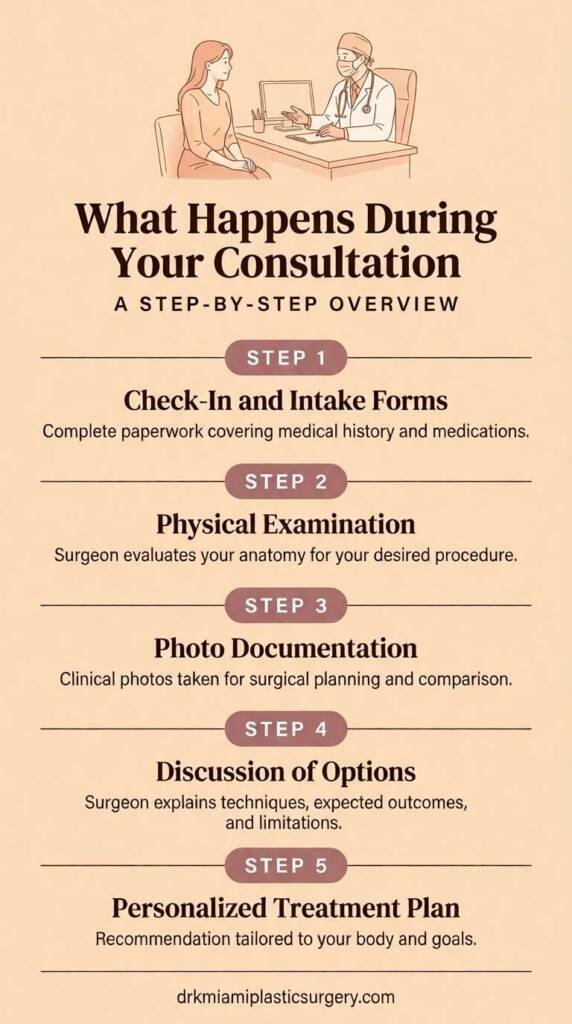
The appointment generally follows this sequence:
- Check-in and intake forms: You complete paperwork covering your medical history, allergies, and current medications
- Physical examination: The surgeon evaluates your anatomy as it relates to your desired procedure
- Photo documentation: Clinical photos are taken for surgical planning and before-and-after comparison
- Discussion of options: The surgeon explains techniques, expected outcomes, and any limitations
- Personalized treatment plan: You receive a recommendation tailored to your body and goals
After the clinical portion, you’ll often meet with a patient coordinator to discuss scheduling, costs, and financing options.
How to prepare for your plastic surgery consultation
Arriving organized makes a real difference. The more information you bring, the more specific and useful the surgeon’s recommendations will be.
What to bring to your consultation
Gather these items before your appointment:
- Photo ID and insurance card (if applicable to your procedure)
- List of current medications and supplements, including dosages
- Medical records from any relevant past surgeries
- Reference photos showing results you find appealing
- Written questions you want answered during the visit
How to document your goals and medical history
Before your appointment, take a few minutes to write down exactly what you want to change and why. Being specific helps—”I want my abdomen to look flatter after pregnancy” gives the surgeon more to work with than “I want to look better.”
Honesty about your medical history matters just as much. Previous surgeries, chronic conditions, smoking habits, and all medications (even supplements) directly affect your surgical plan and safety. Withholding information doesn’t protect you—it puts you at risk.
Questions to ask about your plastic surgeon’s credentials
Not all doctors performing cosmetic procedures have the same level of training. Verifying qualifications is one of the most important steps you can take before committing to surgery.
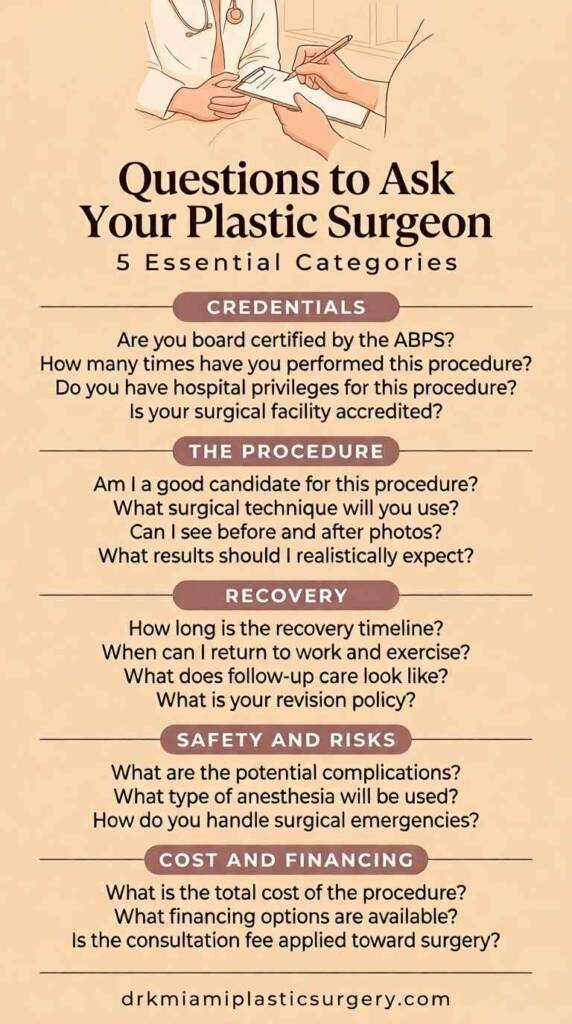
Are you board certified by the American Board of Plastic Surgery
Board certification by the American Board of Plastic Surgery (ABPS) indicates the surgeon completed more than six years of surgical training, passed rigorous written and oral examinations, and commits to ongoing education. This certification differs from general “board certification,” which can come from less rigorous boards with lower standards.
How many times have you performed this procedure
Experience volume correlates with outcomes. A surgeon who performs your desired procedure regularly—say, 50 to 100 times per year—will likely have refined their technique and encountered a wider range of anatomical variations than someone who does it occasionally.
Don’t hesitate to ask for specific numbers. A confident surgeon will share them openly.
Do you have hospital privileges for this procedure
Hospital privileges mean a hospital has reviewed the surgeon’s credentials and granted permission to perform surgery there. Even if your procedure takes place in an outpatient surgical center, hospital privileges indicate the surgeon meets strict credentialing standards beyond what’s legally required.
Is your surgical facility accredited
Accreditation from organizations like AAAASF (American Association for Accreditation of Ambulatory Surgery Facilities) or JCAHO (Joint Commission on Accreditation of Healthcare Organizations) confirms the facility meets safety protocols, maintains proper equipment, and has emergency preparedness plans in place.A review of 42,720 consecutive cases in accredited outpatient settings found an overall complication rate of just 0.74%.
Questions to ask about your procedure
Once you’ve established the surgeon’s credentials, shift your focus to the specifics of what surgery involves and what results you can realistically expect.
Am I a good candidate for this procedure
Candidacy depends on several factors: your overall health, skin elasticity, body mass index, and whether your expectations align with what the procedure can deliver. A responsible surgeon will tell you honestly if you’re not an ideal candidate—or if a different procedure might serve you better.
What surgical technique will you use
Different techniques produce different results. For example, a tummy tuck can be performed as a full abdominoplasty or a mini tuck, each with distinct scarring patterns and recovery timelines. Ask why the surgeon recommends one approach over another for your specific anatomy.
Can I see before and after photos of your patients
Reviewing the surgeon’s portfolio gives you a realistic sense of their aesthetic style and skill level. Look for patients with similar body types and goals to yours—their results offer the best preview of what you might expect.
What results should I realistically expect
A trustworthy surgeon discusses both what the procedure can achieve and its limitations. If someone promises perfection or guarantees specific outcomes, consider that a warning sign rather than reassurance.
Questions to ask about recovery and aftercare
Understanding recovery before surgery helps you plan your life around the procedure—arranging time off work, lining up help at home, and setting realistic expectations for when you’ll see final results.
How long is the recovery timeline
Recovery unfolds in phases. Initial healing—when swelling and bruising are most prominent—typically lasts 1 to 2 weeks for many procedures. Returning to normal activities might take 4 to 6 weeks, while final results can take 6 to 12 months to fully emerge as swelling resolves.
| Recovery Phase | Typical Timeline |
|---|---|
| Initial healing (rest, limited activity) | 1–2 weeks |
| Return to desk work | 1–3 weeks |
| Return to exercise | 4–8 weeks |
| Final results visible | 6–12 months |
When can I return to work and exercise
The answer varies significantly by procedure. A rhinoplasty patient might return to desk work within a week, while someone recovering from a tummy tuck may need 2 to 3 weeks before resuming sedentary work and 6 to 8 weeks before exercising.
What does follow-up care look like
Post-operative appointments are essential for monitoring healing and catching any complications early. Most surgeons schedule follow-ups at 1 week, 2 weeks, 6 weeks, and 3 months post-surgery, though this varies by procedure and practice.
What is your revision policy
Ask how the practice handles results that don’t meet expectations. Some surgeons include minor revisions in their surgical fee within a certain timeframe, while others charge separately. Clarifying this upfront prevents surprises later.
Questions to ask about safety and risks
Every surgery carries risks. A surgeon who discusses complications openly—rather than minimizing them—demonstrates the kind of transparency you want in your care team.
What are the potential complications
Common risks worth discussing include:
- Infection: Signs to watch for and prevention measures
- Scarring: Expected scar placement and how scars typically heal
- Anesthesia risks: Potential reactions and monitoring protocols
- Procedure-specific risks: Such as asymmetry, nerve damage, or fat necrosis (death of fat tissue due to disrupted blood supply)
What type of anesthesia will be used
Anesthesia options include local anesthesia (numbing a specific area), IV sedation (twilight sleep), and general anesthesia (fully unconscious). Ask who administers the anesthesia—ideally a board-certified anesthesiologist or certified nurse anesthetist—and how you’ll be monitored throughout.
How do you handle surgical emergencies
Even in outpatient settings, emergencies can occur. Ask about on-site emergency equipment, staff training, and protocols for hospital transfer if complications arise.
Questions to ask about cost and financing
Cosmetic procedures are typically not covered by insurance, so understanding the full financial picture helps you plan appropriately and avoid unexpected expenses after surgery.
What is the total cost of the procedure
Request an itemized breakdown that includes:
- Surgeon’s fee
- Anesthesia fee
- Facility fee
- Post-operative garments and supplies
- Follow-up appointments
Plastic surgery costs vary widely by procedure and geographic location. Getting a detailed quote upfront prevents surprises when the final bill arrives.
What financing options are available
Many practices offer financing through companies like CareCredit or Alphaeon, which provide payment plans with varying interest rates. Some offices also offer in-house financing. Ask about terms, interest rates, and whether there are penalties for early payoff.
Is the consultation fee applied toward surgery
Some practices charge a consultation fee—typically $100 to $300—that gets credited toward your surgical cost if you proceed. Others offer complimentary consultations. Clarify this before booking your appointment.
Red flags to watch for at a plastic surgery consultation
Not every consultation will feel right. Recognizing warning signs can protect you from poor outcomes:
- Pressure to book immediately: Ethical surgeons give you time to make an informed decision
- Vague answers: Inability to clearly explain techniques, risks, or credentials
- No physical examination: Recommendations made without proper evaluation
- Unusually low pricing: May indicate hidden costs or compromised safety standards
- Limited before and after photos: Raises questions about experience
- Dismissive communication: Rushing through your questions or minimizing concerns
What happens after your plastic surgery consultation
After your consultation ends, you’ll typically receive a written quote outlining all costs. If you decide to proceed, the next steps include scheduling your surgery date, completing any required pre-operative testing (blood work, medical clearances), and receiving detailed pre-surgery instructions.
Take time to review everything before committing. A good practice will give you space to consider your options without pressure.
Frequently asked questions about plastic surgery consultations
Can I have a virtual plastic surgery consultation instead of an in-person visit?
Many plastic surgeons offer virtual consultations for initial discussions. However, an in-person evaluation is typically required before surgery to accurately assess your anatomy and develop a surgical plan.
Should I get a second opinion before scheduling plastic surgery?
Getting a second opinion is common and can help you compare recommendations, build confidence in your decision, and ensure you’ve found the right surgeon for your goals.
Is my plastic surgery consultation confidential?
Yes. Plastic surgery consultations are protected by HIPAA (Health Insurance Portability and Accountability Act), and your medical information and photos remain confidential.
How far in advance should I schedule my consultation before my desired surgery date?
Scheduling your consultation 4 to 8 weeks before your desired surgery date allows adequate time for pre-operative preparation, medical clearances, and thoughtful decision-making.
Book your plastic surgery consultation in Miami with Dr. Kachniarz
At Dr. K Miami Plastic Surgery, every consultation is designed to be thorough, unhurried, and completely personalized to your goals. Dr. Bart Kachniarz takes the time to understand what you’re hoping to achieve, answers every question with honesty, and creates a treatment plan tailored specifically to you.
Whether you’re local to Miami or traveling from out of town, the experience is designed to feel supportive from the first conversation through your final follow-up.
Schedule your consultation today and begin your journey with confidence.