

Key Takeaways
A fleur de lis tummy tuck is a specialized form of abdominoplasty for certain patterns of excess abdominal skin. The right choice depends on skin laxity, muscle separation, health, goals, and comfort with a more visible scar.
- It removes excess skin in both vertical and horizontal directions.
- The incision usually creates an upside-down T-shaped scar.
- It may be considered after significant weight loss or major changes in body shape.
- Muscle tightening and belly-button repositioning may be part of the operation.
- A consultation is essential because recovery, risks, and results vary by patient.
What a fleur de lis tummy tuck is
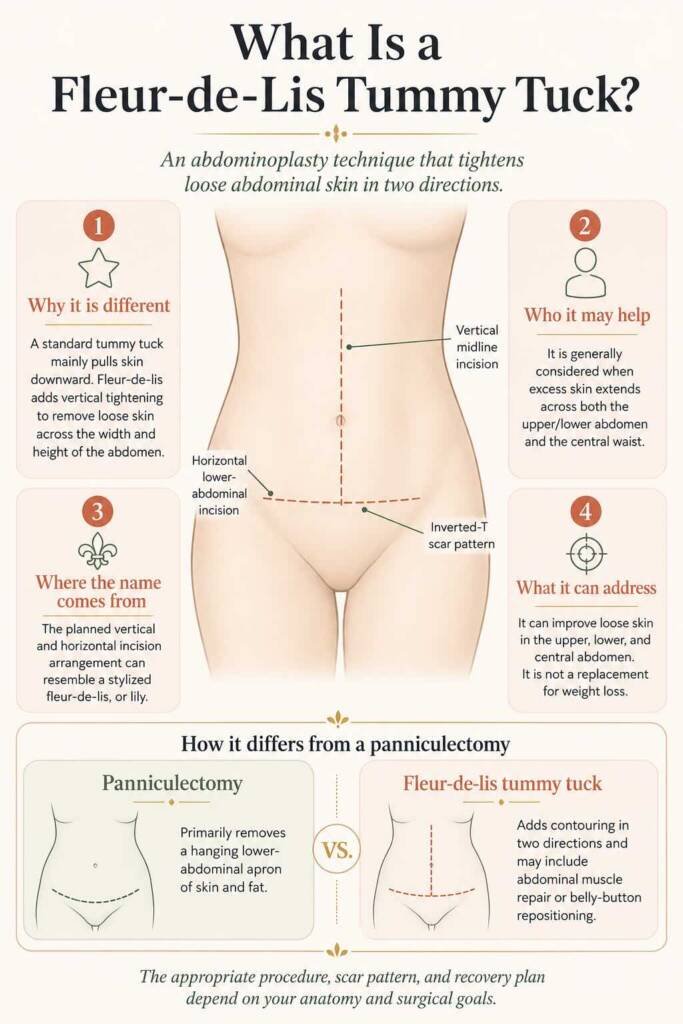
A fleur de lis tummy tuck is an abdominoplasty technique that uses both a horizontal lower-abdominal incision and a vertical midline incision. This allows a surgeon to remove loose skin in more than one direction, rather than pulling only the lower abdominal skin downward. It is generally reserved for people whose excess skin extends across the width and height of the abdomen.
A fleur de lis tummy tuck guide can help explain the basic procedure, but it cannot determine whether the technique is appropriate for an individual.
How the fleur de lis incision differs from a standard tummy tuck
A standard tummy tuck usually relies on a horizontal incision low on the abdomen. The fleur de lis approach adds a vertical incision up the center of the abdomen, allowing skin to be tightened inward as well as downward. The resulting scar pattern often resembles an upside-down letter T, although its exact length and shape depend on anatomy and the surgical plan.
Why the procedure is named after the fleur de lis shape
The name comes from the fleur de lis, a stylized lily shape. When the vertical and horizontal incisions are planned and closed, their arrangement can resemble that three-petaled form. The name describes the incision pattern, not a separate implant, device, or cosmetic product.
What areas of the abdomen it can address
This technique can address loose skin in the lower abdomen, upper abdomen, and central abdominal area when laxity runs in both directions. It may also improve the contour created by a broad, relaxed abdominal skin envelope. The amount of tissue removed varies, and the procedure is not intended to replace weight loss or treat every concern involving abdominal fullness.
How it differs from a panniculectomy
A panniculectomy primarily removes a hanging apron of skin and fat, often near the lower abdomen. It may not include the same degree of abdominal contouring, muscle repair, or belly-button repositioning associated with an abdominoplasty. The distinction is meaningful because the operations have different goals, incisions, recovery expectations, and potential costs.
Who may benefit from this procedure
The fleur de lis tummy tuck is most often discussed with people who have a substantial amount of loose abdominal skin, particularly after major weight reduction. Pregnancy, aging, and changes in body size can also affect skin and muscle position, though not everyone with loose skin needs this more extensive approach. Candidacy is determined through an examination, medical history, and conversation about realistic goals.
Significant weight loss and excess abdominal skin
After significant weight loss, skin may not contract enough to match the reduced body volume. Some people have folds that hang below the abdomen, while others have laxity that wraps around the sides or rises toward the ribcage. A fleur de lis tummy tuck may be considered when a horizontal-only operation would leave too much looseness behind.
How loose skin can extend horizontally and vertically
Skin laxity can spread from side to side and from the lower abdomen toward the upper abdomen. Pulling the skin downward can improve one dimension while leaving fullness or looseness across the midline. The additional vertical component gives the surgeon another direction in which to remove tissue, but it also creates another scar that must be accepted as part of the trade-off.
The role of abdominal muscle separation
Weight changes and pregnancy can contribute to separation or laxity of the abdominal wall. When present, muscle separation may be evaluated during planning and, if appropriate, repaired as part of abdominoplasty. Muscle tightening is not automatic for every patient, and it should not be described as a substitute for strengthening exercises or weight management.
When body shape and skin quality affect candidacy
Body proportions, previous scars, skin elasticity, fat distribution, and the location of the navel all influence the plan. Stable weight and generally good health are helpful because significant future weight changes can alter the result. At Dr. K Miami Plastic Surgery, the consultation process should be used to discuss the patient’s anatomy and priorities rather than to fit every person into the same incision pattern.
How the surgery is performed
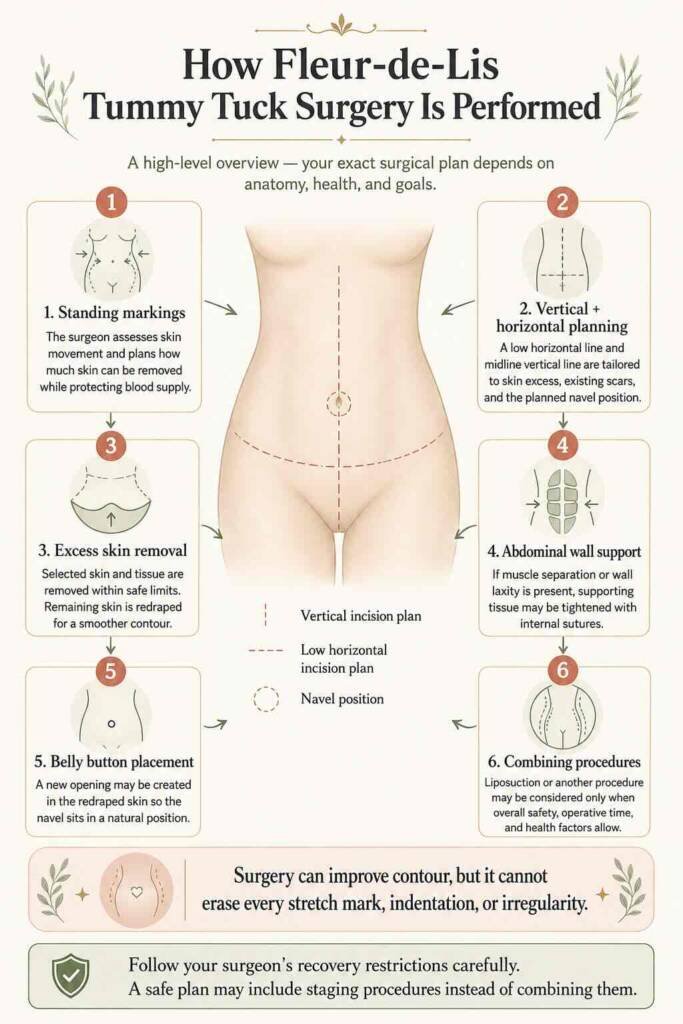
The operation begins with careful marking while the patient is standing, because folds and skin movement are easier to assess in that position. The surgeon plans how much skin can be removed while preserving blood supply and creating a natural contour. The exact technique varies with anatomy, previous operations, and whether muscle repair or another procedure is included.
Planning the vertical and horizontal incisions
The horizontal incision is usually placed low enough to be concealed by underwear or swimwear when possible. The vertical incision is planned along the abdominal midline, with its length determined by the location and amount of excess skin. Previous scars, stretch marks, the ribcage, and the intended position of the belly button all affect the markings.
Removing excess skin and tissue
After the incisions are made, the surgeon separates and removes selected excess skin and tissue. The amount is limited by safety considerations, tissue quality, and the need to close the wound without excessive tension. The remaining skin is repositioned to create a smoother surface, but surgery cannot erase every stretch mark, indentation, or irregularity.
Tightening the abdominal wall
If abdominal muscle separation or wall laxity is present, the surgeon may tighten the supporting tissue with internal sutures. This step is individualized and may affect early comfort, posture, and movement. It is also one reason patients need to follow restrictions carefully during the first part of recovery.
Creating or repositioning the belly button
Because the abdominal skin is moved, the original opening for the belly button may no longer sit in a natural position. The surgeon may create a new opening in the redraped skin and preserve the navel itself. The final appearance depends on healing, scar formation, swelling, and the relationship between the navel and surrounding contour.
Combining the procedure with liposuction or other surgery
Liposuction or another operation may sometimes be discussed, but combining procedures is not automatically safer or better. The decision depends on operative time, blood-loss risk, anesthesia considerations, and the patient’s health. A personalized plan at Dr. K Miami Plastic Surgery should explain which procedures are appropriate together and which may be safer when staged.
Fleur de lis tummy tuck compared with other options
There is no single best tummy tuck for every body shape. A traditional, mini, extended, or fleur de lis approach may be considered according to where the loose skin is located and how much correction is needed. Comparing traditional and fleur de lis techniques can help frame the decision, but an in-person examination remains more useful than photographs or general descriptions alone.
Fleur de lis versus a traditional tummy tuck
A traditional tummy tuck primarily removes lower-abdominal skin through a horizontal incision and may tighten the abdominal wall. A fleur de lis tummy tuck adds vertical skin removal for patients with laxity across the upper or central abdomen. The latter can provide broader skin tightening, but it also involves a longer and more visible scar pattern.
Fleur de lis versus a mini tummy tuck
A mini tummy tuck generally addresses a smaller amount of excess skin below the belly button. It may be suitable when laxity is limited and the upper abdomen is relatively firm. It usually cannot provide the same degree of vertical skin removal as a fleur de lis operation, so choosing it for extensive laxity may leave the central or upper abdomen undertreated.
Fleur de lis versus a panniculectomy
A panniculectomy focuses on removing an overhanging apron of skin and fat. A fleur de lis tummy tuck is more commonly planned as a contouring operation that may include muscle repair and a new belly-button opening. Patients should ask exactly which steps are included, because the names can sound similar while the surgical goals differ.
When extended abdominoplasty may be enough
An extended abdominoplasty lengthens the horizontal incision toward the sides of the body. It may be enough when the main problem is lower-abdominal and flank skin laxity without substantial vertical excess. If skin also needs to be removed from the upper abdomen toward the midline, the fleur de lis approach may offer a more direct solution.
Benefits and limitations to consider
The potential benefit is more complete removal of loose skin when laxity exists in two directions. Some patients may experience a flatter-looking abdomen, improved clothing fit, and a more defined transition between the waist and torso. Those possible improvements must be weighed against a larger operation, a longer recovery, and scars that can remain noticeable.
The amount of contouring the procedure can provide
Removing both vertical and horizontal excess can narrow the abdominal skin envelope more extensively than a downward pull alone. The result may look smoother and less boxy when the patient’s anatomy is well suited to the technique. The scar is part of the result, not a minor detail to consider after the operation has been chosen.
Why the vertical scar is a significant trade-off
The vertical scar is usually the clearest difference between this operation and a standard tummy tuck. It may extend from the lower abdomen toward the navel or higher, depending on the amount of skin removed. Scar quality is influenced by genetics, tension, wound healing, sun exposure, and aftercare, so no surgeon can promise that it will fade completely.
Potential effects on waist definition and clothing fit
Reducing excess skin may make the waist appear more defined and allow clothing to sit more comfortably over the abdomen. These changes are contour improvements, not guarantees of a particular clothing size or body proportion. Weight stability and the distribution of remaining fat continue to affect how the result looks over time.
Factors that can limit the final result
Results may be limited by skin quality, residual fat, uneven healing, prior abdominal surgery, muscle weakness, or future weight changes. Swelling can also make the early contour look different from the eventual result. Patients who want a highly specific shape should discuss what is realistically achievable before consenting to surgery.
Risks, complications, and safety considerations
A fleur de lis tummy tuck is major surgery, and the longer incision and larger treatment area can affect both recovery and risk. Common effects such as swelling and discomfort are expected, while other problems may require additional treatment. Safety depends on the patient’s health, the surgical plan, the facility, anesthesia care, and close follow-up.
Common short-term side effects
Bruising, swelling, tightness, fatigue, numbness, and discomfort are common early experiences. Some people temporarily walk slightly bent at the waist because the abdominal skin and muscles feel tight. Pain control, movement, hydration, and wound care should follow the surgeon’s instructions rather than a generic online schedule.
Possible wound-healing and scarring problems
Incisions can separate, heal slowly, become unusually thick, or develop areas of widened or darkened scarring. The meeting point of the vertical and horizontal incisions may receive particular tension and deserve careful monitoring. Smoking, nicotine exposure, poor nutrition, infection, and uncontrolled medical conditions can make healing more difficult.
Seroma, infection, blood clots, and other complications
A seroma is a collection of fluid beneath the skin and may require observation, drainage, or other treatment. Infection, bleeding, skin loss, changes in sensation, contour irregularity, and anesthesia complications are also possible. Blood clots are less common but potentially serious; the surgical team should explain prevention and the warning signs that require urgent attention.
Medical conditions and habits that can increase risk
Risk may be higher with nicotine use, poorly controlled diabetes, obesity, blood-clotting disorders, certain medications, or significant heart and lung disease. Previous abdominal operations can change blood supply and incision planning. Patients should give a complete medication and health history and should not stop prescribed medicines without medical guidance.
Questions to discuss with a board-certified plastic surgeon
A consultation should leave the patient with a clear understanding of both the intended improvement and the limitations. Useful questions include:
- Why is a fleur de lis approach recommended for my pattern of skin laxity?
- Where will the scars be, and how might they change over time?
- What steps will be included, such as muscle repair or liposuction?
- What are the warning signs after surgery, and who should I contact?
These questions can make the conversation more concrete and reveal whether the proposed plan matches the patient’s priorities. Dr. K Miami Plastic Surgery can be one setting in which patients ask about the surgeon’s training, complication rates, follow-up process, and facility arrangements before making a decision.
Recovery after a fleur de lis tummy tuck
Recovery is gradual, and the first few days are usually the most physically demanding. Patients often need help at home, especially with standing, bathing, meals, and caring for children. The surgeon’s instructions take priority because the timeline changes with the extent of surgery and the patient’s healing response.
What to expect immediately after surgery
Early recovery may include abdominal tightness, swelling, bruising, fatigue, and limited mobility. Medication can help manage discomfort, but pain that suddenly worsens or is not controlled should be reported. Short, supported walks are often encouraged when medically appropriate because complete bed rest can increase other risks.
Drains, compression garments, and movement restrictions
Temporary drains may be used to remove fluid while the tissues heal, and they require specific emptying and measurement instructions. A compression garment may support the abdomen and help manage swelling if prescribed. Heavy lifting, strenuous bending, and direct stress on the incision are usually restricted until the surgeon confirms that activity can increase safely.
Typical timeline for returning to work and exercise
A desk-based worker may return sooner than someone whose job involves lifting, prolonged standing, or frequent movement. Exercise generally resumes in stages, beginning with walking and progressing only after medical clearance. Even when energy returns, internal tissues may still be healing, so feeling better is not by itself a signal to resume every activity.
How scars change during healing
Scars often look pink, firm, raised, or darker in the early months before gradually softening and fading. Their final appearance can take a year or longer to mature. Incision care, sun protection, and any recommended scar treatment should be discussed with the surgical team, particularly if healing appears uneven.
When swelling and final results may stabilize
Swelling usually improves gradually rather than disappearing all at once. One side may settle faster than the other, and temporary numbness or firmness can persist. The final contour is commonly assessed after substantial healing has occurred, with the exact timing determined by the surgeon’s examination.
Cost and preparation for surgery
The price of a fleur de lis tummy tuck varies because the operation is tailored to the patient rather than sold as a single standardized service. Preparation also involves more than arranging payment: medical clearance, home support, time away from work, and realistic expectations all matter. A detailed consultation should explain what is included and what may be billed separately.
What can influence the total cost
Factors may include surgeon and anesthesia fees, facility charges, the length and complexity of surgery, postoperative garments, laboratory testing, medications, and follow-up care. Additional procedures can change both the fee and recovery needs. Patients should request a written estimate and ask whether treatment of a complication or revision would involve additional charges.
Why insurance coverage is uncommon
Because abdominoplasty is often performed for body contouring, insurance coverage is uncommon. A panniculectomy may be assessed differently when excess skin causes documented functional problems, but policies vary and approval is not guaranteed. Patients should contact their insurer directly and avoid assuming that a procedure’s medical terminology determines coverage.
Medical evaluations and lifestyle preparation
The surgeon may request a physical examination, medication review, laboratory testing, and other clearance based on medical history. Reaching a stable weight, arranging transportation, preparing a recovery space, and stopping nicotine as instructed can support safer planning. Patients should also organize help at home rather than expecting to manage every normal responsibility immediately after surgery.
Questions to ask during a consultation
A useful consultation covers the incision plan, muscle repair, anesthesia, recovery, follow-up, and alternatives. Ask how the surgeon would adapt the operation to previous scars, changing weight, or future pregnancy plans. It is also reasonable to ask what would make the surgeon recommend a different procedure or delay surgery.
How to evaluate a surgeon’s experience and facility credentials
Look for appropriate board certification, experience with complex body-contouring surgery, and a facility accredited or licensed according to applicable standards. Ask who provides anesthesia and where emergency care would occur if needed. A practice such as Dr. K Miami Plastic Surgery should be evaluated through the same practical questions: credentials, communication, follow-up access, and whether the proposed plan feels individualized rather than rushed.
Conclusion
A fleur de lis tummy tuck can address substantial abdominal skin laxity that extends both vertically and horizontally, but its broader contouring comes with a prominent scar and significant recovery. The safest choice is made after a candid assessment of anatomy, health, goals, alternatives, and long-term expectations with a qualified plastic surgeon.
Frequently Asked Questions
Is a fleur de lis tummy tuck only for people who lost weight?
No. It is often considered after significant weight loss, but the incision pattern may also be discussed for other patients with loose skin extending in both directions. Suitability depends on anatomy and overall health.
What does the scar usually look like?
The scar commonly includes a low horizontal line and a vertical line along the abdominal midline, creating an upside-down T pattern. Its length, visibility, and final texture vary with the surgical plan and healing.
Does the procedure tighten abdominal muscles?
It may include repair of abdominal wall separation or laxity when that is present and appropriate. Muscle repair is individualized and should be discussed specifically during consultation.
How long does recovery take?
Early recovery often lasts several weeks, while swelling, numbness, and scar maturation can continue for months. Work and exercise timelines depend on the job, the extent of surgery, and the surgeon’s clearance.
Can liposuction be performed at the same time?
Sometimes, but combining procedures depends on safety, operative time, blood-loss concerns, and the patient’s medical condition. Some procedures may be safer when performed separately.
Is a fleur de lis tummy tuck permanent?
Removed skin does not grow back, but major weight changes, pregnancy, aging, and changes in skin quality can alter the contour. Stable weight helps protect the result.
How do I know whether I need this procedure?
An examination is needed to determine where skin laxity is located and whether a traditional, mini, extended, or fleur de lis approach is more suitable. A consultation should also cover risks, scars, recovery, and alternatives.