
Key Takeaways
Cellulite is common, harmless, and influenced by the structure beneath the skin as well as lifestyle and aging. The best cellulite treatment depends on the appearance you want to change, your health, and how much downtime you can accept.
- Cellulite is not simply a problem of body weight or fitness.
- Lifestyle habits may improve skin health and muscle tone, but rarely erase cellulite.
- Creams and massage tend to provide modest or temporary visual improvement.
- Energy-based and tissue-release procedures address different parts of cellulite’s structure.
- A qualified medical consultation is the safest way to compare options.
How cellulite treatments work
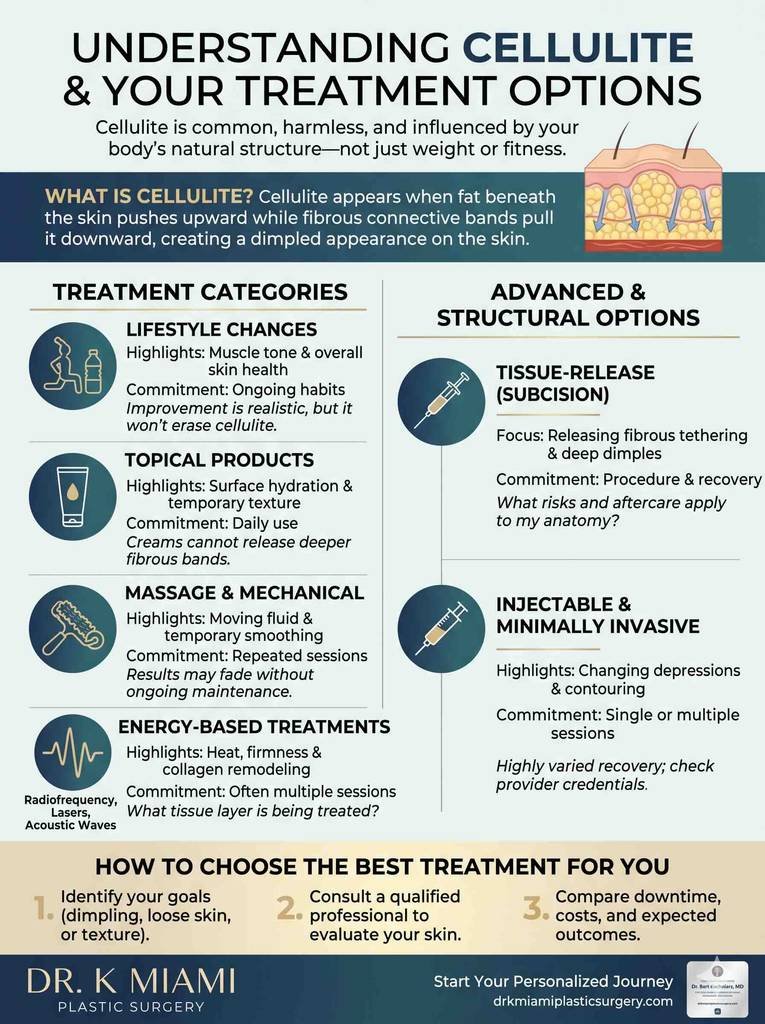
Cellulite appears when fat beneath the skin pushes upward while fibrous connective bands pull the skin downward. The resulting dimples can become more visible as skin loses elasticity, although cellulite can affect people of many body types.
Treatments generally take one or more approaches: improving the skin’s surface, temporarily changing fluid movement, heating tissue, reducing the pull of fibrous bands, or supporting collagen remodeling. Some methods are noninvasive, while others involve needles, small incisions, or a longer recovery. Expectations matter as much as technique, because most procedures reduce the appearance of cellulite rather than permanently changing every feature of the skin.
The right comparison is not always the treatment with the most dramatic advertisement. It is the option that matches the cause of the dimpling, the area being treated, your medical history, and your willingness to maintain results. A consultation should also cover possible side effects, the number of sessions involved, and what improvement can realistically look like on your skin.
Lifestyle changes for reducing cellulite’s appearance
Exercise, nutrition, hydration, and weight stability can support healthier-looking skin, but they should not be presented as a cure for cellulite. Building muscle may create a firmer contour, while gradual weight management can change the amount of fat beneath the skin. Even so, the connective bands that contribute to dimpling can remain after weight loss.
A practical routine is usually more helpful than an extreme plan. Regular resistance training for the legs and glutes, moderate cardiovascular activity, adequate protein, and habits that support overall health can improve tone and confidence. These changes may also make later cosmetic treatment easier to assess because your weight and daily routine are more stable.
Lifestyle measures are best viewed as a foundation rather than a replacement for medical care. If cellulite changes suddenly, becomes painful, or is associated with swelling or other symptoms, seek an appropriate medical evaluation instead of assuming it is ordinary cellulite. For elective cosmetic concerns, a practice such as Dr. K Miami Plastic Surgery can discuss goals in the context of overall health and personalized care.
1. Topical creams and lotions
Topical products are appealing because they are easy to apply and do not require recovery time. Formulas may contain ingredients intended to moisturize, temporarily tighten the skin’s surface, or support the appearance of smoother texture. Their effects are usually subtle, and consistent application is often necessary to maintain whatever improvement appears.
A cream cannot reliably release the deeper fibrous bands or permanently remove the fat associated with cellulite. Caffeine-containing products, for example, may create a short-lived tightening or de-puffed look, while retinoid-based products may support collagen over time for some users. Irritation, dryness, and sensitivity are possible, particularly with stronger active ingredients.
Read claims carefully and patch-test new products when appropriate. Sunscreen remains useful for protecting skin quality, although it does not treat cellulite itself. If a product causes burning, a rash, or persistent redness, stop using it and ask a clinician or dermatologist for guidance rather than layering on more products.
2. Massage and mechanical treatments
Massage-based approaches may temporarily improve the look of cellulite by moving fluid in the treated area and creating a smoother surface appearance. Mechanical treatments can use suction, rollers, or other forms of tissue manipulation. They are generally less invasive than procedures that break or release connective bands, but their visible effects may fade without repeated sessions.
The experience can vary considerably depending on pressure, device settings, treatment frequency, and individual sensitivity. Bruising, tenderness, or temporary swelling can occur, especially when stronger suction is used. People with certain vascular conditions, clotting concerns, active skin problems, or unexplained swelling should ask a qualified clinician whether this type of treatment is appropriate.
A realistic plan treats massage as a possible appearance-enhancing measure, not a structural fix. It may suit someone who wants little downtime and accepts maintenance, while someone bothered by deep, persistent dimples may need to discuss a different category of treatment. Combining methods should be guided by a professional rather than assembled from unrelated spa or online recommendations.
3. Radiofrequency and heat-based treatments
Radiofrequency and other heat-based treatments deliver energy into the skin and underlying tissue. Depending on the device and treatment plan, the goal may include temporary contraction, collagen remodeling, or an improvement in skin firmness and texture. These treatments are often selected by people who want a non-surgical approach with limited downtime.
Results are gradual because collagen remodeling takes time, and several appointments may be recommended. Warmth, redness, swelling, and tenderness are possible afterward. Treatment settings should be chosen for the individual area and skin characteristics, since excessive heat can cause injury while insufficient energy may produce little visible change.
The treatment may be more useful when laxity and surface texture are part of the concern, rather than when deep tethering is the dominant feature. During consultation, ask which layer is being treated, how improvement will be measured, and whether maintenance sessions are expected. Dr. K Miami Plastic Surgery approaches cosmetic procedures through personalized planning, with safety and patient support included in the discussion rather than treated as afterthoughts.
4. Laser treatments for cellulite
Laser treatments use concentrated energy to heat or alter targeted tissue. Some approaches are noninvasive and focus on skin texture or firmness, while minimally invasive laser procedures may work closer to the fibrous structures beneath the skin. The exact effect depends on the device, its approved use, the practitioner’s technique, and the patient’s anatomy.
Laser treatment is not one universal category, so asking for the specific device and treatment goal is essential. Possible short-term effects include redness, swelling, bruising, tenderness, or temporary changes in sensation. Minimally invasive approaches may involve small entry points and a recovery period, which should be explained before scheduling.
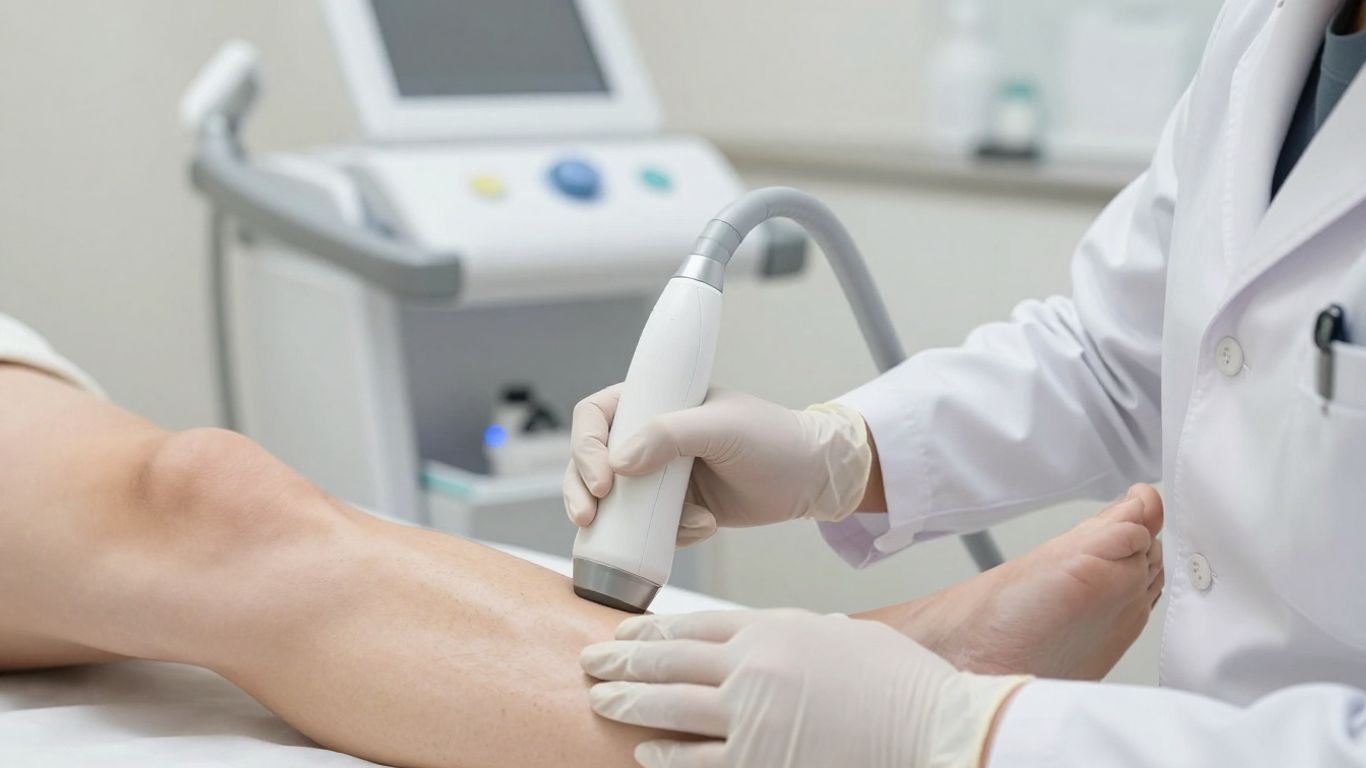
People considering laser options should compare expected improvement with the risks of heat and invasiveness. The cellulite reduction treatment information available from the American Board of Cosmetic Surgery also places laser and non-laser energy treatments among several possible approaches, rather than treating one method as universally best. A careful consultation can clarify whether the concern is mainly loose skin, surface texture, fat distribution, or tethering.
5. Acoustic wave therapy
Acoustic wave therapy uses pulses of mechanical energy applied to the skin and underlying tissue. It is intended to influence tissue characteristics and may improve the appearance of cellulite over a series of treatments. Because it does not require a surgical incision, it can appeal to people who prioritize a shorter recovery.
Treatment often involves repeated appointments, and improvement may develop gradually. Some patients experience temporary soreness, redness, or sensitivity in the treated area. The quality of the result can depend on the device, the treatment protocol, and the depth and pattern of cellulite being addressed.
Acoustic wave therapy is best discussed as one option within a broader treatment plan. It may not be enough for pronounced dimpling caused by strong fibrous tethering, and it should not be confused with fat removal. Ask how many sessions are typical, what evidence supports the specific device, and how the provider will judge whether the treatment is working.
6. Subcision and tissue-release procedures
Subcision and related tissue-release procedures focus directly on fibrous bands that pull the skin downward. A clinician uses a needle or specialized instrument beneath the skin to release selected tethered areas, allowing the surface to appear flatter. This approach is structurally different from a cream or surface massage because it addresses one of the forces creating a depression.
Because the procedure is minimally invasive, bruising, swelling, soreness, bleeding, infection, contour irregularity, and temporary or lasting sensory changes are possible. The number and depth of releases depend on the pattern of cellulite, skin thickness, and the practitioner’s assessment. Recovery instructions may include limits on exercise or pressure for a period of time.
Tissue release can be considered when individual dimples are clearly defined and persistent. It is not a promise of perfectly smooth skin, and it may not address laxity or excess fat on its own. During a consultation, ask whether additional skin-tightening or contouring treatment is being proposed and why the combination is appropriate for your anatomy.
7. Injectable and minimally invasive treatments
Injectable and minimally invasive options range from substances placed beneath the skin to procedures that use small access points or instruments. Their goals may include changing the appearance of a depression, altering nearby tissue, or supporting a smoother contour. The risks and recovery vary widely, so the category should never be treated as a single treatment.
A provider should explain the exact substance or device, where it will be placed, how long results may last, and what happens if the outcome is uneven or unsatisfactory. Swelling, bruising, pain, infection, nodules, allergic reactions, and contour changes are among the concerns that may apply depending on the procedure. Product approval and appropriate use also matter, particularly when a treatment is marketed broadly online.
For people considering an invasive option, credentials and follow-up are as important as the procedure itself. Dr. K Miami Plastic Surgery provides aesthetic plastic surgery and cosmetic procedures, so a consultation can be used to discuss a personalized plan, safety considerations, and the full patient journey. The decision should remain grounded in your goals, not pressure to choose the most involved intervention.
How to choose the best cellulite treatment for you
Start by describing the appearance you want to change: diffuse dimpling, a few deep depressions, loose skin, uneven texture, or a combination. Then consider your health history, medications, skin sensitivity, budget, available recovery time, and willingness to return for maintenance. A qualified provider should examine the area rather than recommend a procedure based only on a photograph.
The following comparison can help organize an initial conversation, although it cannot replace an in-person assessment:
| Treatment category | Main focus | Typical commitment | Key question to ask |
|---|---|---|---|
| Lifestyle changes | Muscle tone and overall skin health | Ongoing habits | What improvement is realistic without a procedure? |
| Topical products | Surface hydration and temporary texture changes | Daily use | Which ingredients are appropriate for my skin? |
| Energy-based treatments | Heat, firmness, or collagen remodeling | Often multiple sessions | What tissue layer is being treated? |
| Tissue-release procedures | Fibrous tethering and selected dimples | Procedure and recovery | What risks and aftercare apply to my anatomy? |
This framework helps separate a low-downtime maintenance approach from a procedure intended to change deeper tissue. It also makes it easier to compare quoted costs, expected duration, and recovery instead of focusing only on before-and-after photographs. Evidence about cellulite remains imperfect, and results can differ from one person to another.
Before committing, consider these practical questions:
- Who will perform the treatment, and what training do they have?
- Which device, product, or technique will be used?
- How many sessions or follow-up visits should I expect?
- What are the common and serious risks for my skin and medical history?
Answers should be specific, understandable, and documented when appropriate. A practice such as Dr. K Miami Plastic Surgery can be one setting for discussing aesthetic goals with a personalized, safety-conscious approach, but no consultation should promise flawless or permanent results. The best cellulite treatment is the one whose likely benefit, risks, cost, and recovery fit your priorities.
Takeaway
Cellulite treatment is a personal decision, not a test of discipline or fitness. Lifestyle changes may support healthier contours, while topical, mechanical, energy-based, laser, acoustic, injectable, and tissue-release options address different parts of the concern. A thoughtful consultation can help you choose a realistic path that respects your health, comfort, and desired level of change.
Frequently Asked Questions
What is the best cellulite treatment?
There is no single best option for everyone. The most suitable treatment depends on whether the main concern is skin laxity, surface texture, fat distribution, or fibrous tethering, along with your tolerance for cost, downtime, and maintenance.
Can exercise get rid of cellulite?
Exercise may improve muscle tone and the overall contour beneath the skin, which can make cellulite less noticeable. It usually does not remove the connective bands that contribute to dimpling, so complete elimination should not be expected.
Do cellulite creams really work?
Some creams can moisturize the skin or create a temporary smoother appearance. Their effects are generally modest, and topical products do not reliably alter the deeper structures associated with cellulite.
How long do cellulite treatment results last?
Duration varies by treatment, anatomy, aging, weight changes, and maintenance. Some improvements fade gradually, while procedures aimed at structural tethering may last longer but still cannot stop future changes in skin and tissue.
Are cellulite treatments painful?
Sensation varies from warmth or pressure to soreness from needles or tissue manipulation. A provider should explain anesthesia, expected discomfort, bruising, swelling, and recovery before treatment.
Is cellulite a sign of poor health?
No. Cellulite is extremely common and can affect people who are lean, active, and otherwise healthy. Its visibility is influenced by connective tissue, fat distribution, skin elasticity, hormones, and genetics.
When should I see a medical professional about cellulite?
Consider a consultation when the appearance bothers you and you are thinking about treatment. Seek medical evaluation sooner for sudden changes, pain, marked swelling, skin discoloration, or symptoms that do not resemble ordinary cellulite.