
Key Takeaways
A “double D” result is a general aesthetic goal, not a precise implant specification. The final appearance depends on anatomy, implant dimensions, surgical placement, and how each person’s body heals.
- DD is a bra-cup label, not a standardized implant size.
- Implant volume is measured in cubic centimeters, or cc, rather than cup sizes.
- Width, projection, profile, and shape all influence the finished look.
- Existing tissue, skin elasticity, body proportions, and implant placement matter.
- A consultation is the safest way to match goals with suitable implant options.
What “double D” means in breast implant sizing
When someone asks about double D breast implants, they are usually describing the fullness they hope to see after augmentation. They are not naming one universally recognized implant volume. A surgeon must translate that visual goal into dimensions that fit the chest and support a safe, proportionate result.
Why bra cup sizes are not standardized
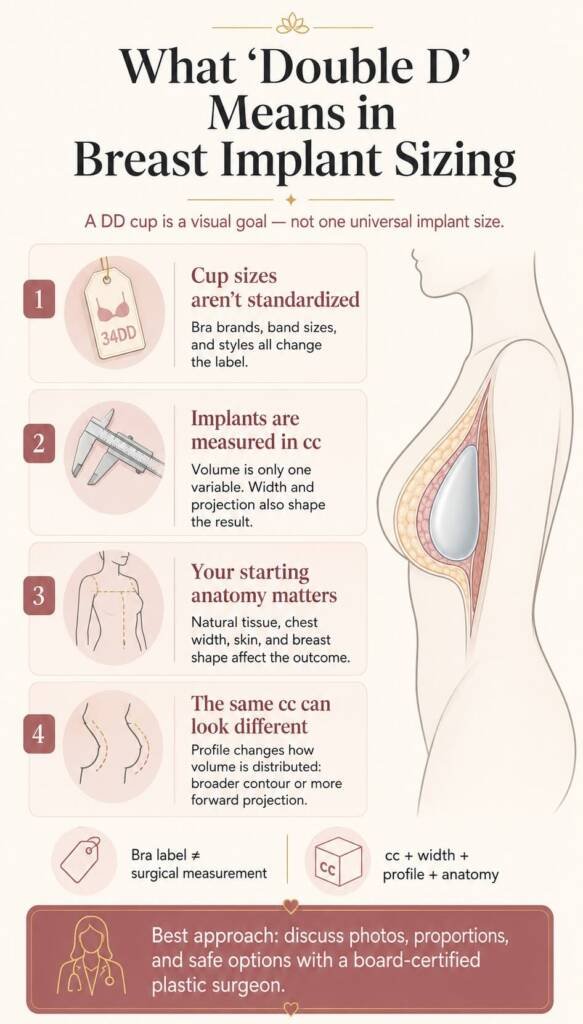
Bra sizing varies among manufacturers, countries, and even styles from the same brand. Band measurements also affect the letter designation, so a DD in one band size may not look or measure like a DD in another. This is why a cup label can help start a conversation, but it cannot serve as a surgical measurement.
A reference such can be helpful, but a physical examination remains more useful than a favorite bra size. Surgeons typically focus on the chest dimensions and the appearance a patient wants to create.
The difference between a DD cup and a D cup
In many conventional sizing systems, DD indicates one cup step above D. That difference can suggest additional fullness, but it does not predict an identical change for every person. The visual distinction may be subtle on one frame and more pronounced on another, especially when the band size, breast shape, and natural tissue differ.
Why implants are measured in cubic centimeters
Implants are described by volume in cubic centimeters, often written as cc. This gives the surgical team a reproducible way to compare options, while cup size remains a variable clothing label. Two implants with the same volume can have different widths and projections, so the number alone does not describe how the breast will look.
How a pre-existing breast size affects the result
An implant adds volume to the tissue already present. Someone beginning with more breast tissue may reach a fuller cup appearance with a smaller implant than someone with very little tissue. The starting shape, the amount of skin, and the position of the nipple also affect the result, which is why a requested cup size must be treated as an estimate rather than a promise.
Typical implant volumes associated with a DD result
There is no single cc number that reliably creates a DD result. In broad discussions, patients may hear ranges in the mid-hundreds of cubic centimeters, but those figures are only rough starting points and should not be used to choose an implant independently. The same volume can look restrained on one body and quite prominent on another.
Common implant volume ranges
Many augmentation options fall somewhere from the low hundreds to several hundred cubic centimeters, with larger choices extending beyond that range. A surgeon may compare several nearby volumes rather than jump directly to one target number. The appropriate range depends on the available breast envelope, chest width, skin quality, and desired degree of fullness.
Why the same implant can produce different cup sizes
An implant’s contribution is layered over the patient’s existing tissue, so the same device does not create the same total breast volume for everyone. Band size changes the cup calculation as well. A person with a narrow rib cage may experience a different cup-label change than someone with a broader chest, even when the implant volume is identical.
How implant profile changes the overall appearance
Profile describes how far an implant projects forward in relation to its base width. A higher-profile implant can create more projection without being as wide, while a moderate profile may distribute volume over a broader area. These choices influence upper-pole fullness, side contour, and how prominent the breasts appear in clothing.
Why implant volume alone cannot predict bra size
Cup size is affected by measurements, tissue coverage, implant shape, swelling during recovery, and the bra itself. It is more useful to discuss photographs, proportions, and the desired contour than to insist on an exact letter. Online size selection factors can offer context, but they cannot replace an individualized surgical assessment.
Implant dimensions that determine how large breasts look
Volume is only one part of an implant’s identity. Width, height, projection, profile, and shape work together to determine whether the result feels broad and soft, forward and prominent, or somewhere between the two. The best choice usually fits the chest rather than simply maximizing the cc number.
Width, height, and projection
Width describes the implant’s base across the chest, while height describes its vertical dimension. Projection indicates how far it extends forward. These measurements help a surgeon create a breast that sits within the patient’s natural boundaries instead of spreading too far toward the armpit or projecting more than the tissue can comfortably cover.
Moderate, high, and extra-high profiles
Moderate profiles generally distribute volume over a wider base, whereas high and extra-high profiles concentrate more of that volume toward the front. The terms are relative to the implant’s design and manufacturer, so they should be compared within a specific product line. A profile decision is therefore about shape and proportion, not just about looking “bigger.”
How chest width influences implant selection
A wider chest may accommodate a wider implant, while a narrower chest often calls for careful limits on base diameter. Choosing an implant that exceeds the available tissue can create contour concerns and may make the result look less natural. Measurements of the breast footprint and rib cage help keep the selection grounded in anatomy.
The relationship between implant shape and fullness
Round implants and anatomically shaped implants distribute volume differently, although the visible result also depends on placement and the patient’s tissue. Shape can influence upper-breast fullness and the transition into the chest. The goal is to select a form that supports the desired appearance while remaining compatible with the body’s existing contours.
Factors that affect whether implants look like a DD
A cup label cannot capture every feature that determines the final appearance. Natural tissue, skin behavior, body proportions, placement, and future changes all contribute. For patients seeking a full but balanced result, the consultation should address how the goal will look on their particular frame.
Existing breast tissue and skin elasticity
Natural tissue can soften the outline of an implant and provide additional volume, while thinner coverage may make implant edges or rippling more noticeable. Skin elasticity also affects how well the breast envelope accommodates added volume. These differences are not flaws; they are practical factors that shape the available options.
Body proportions and rib cage size
Height, shoulder width, torso length, and rib-cage shape influence how a fuller breast fits the rest of the body. A volume that appears balanced on one person may feel disproportionate on another. The aim is not to force every patient into the same visual category, but to create a result that works with their proportions and preferences.
Placement above or below the chest muscle
Placement can affect contour, coverage, movement, and recovery. Above-muscle placement may preserve certain movement patterns, while below-muscle or dual-plane approaches can provide different tissue coverage and shaping characteristics. The appropriate plane depends on anatomy, implant choice, lifestyle, and the surgeon’s assessment.
Pregnancy, weight changes, and aging
Breast tissue can change after pregnancy, breastfeeding, significant weight fluctuation, and the natural aging process. These changes may alter fullness or skin laxity even when the implants themselves remain unchanged. Discussing future plans helps set expectations and may influence whether augmentation alone is appropriate.
How surgeons choose implants for a desired size
The selection process is a translation exercise: a patient describes a desired look, and the surgeon evaluates what the anatomy can safely support. At Dr. K Miami Plastic Surgery, the practice’s documented focus is aesthetic plastic surgery with personalized outcomes, patient safety, comfort, and support. Those priorities make the conversation broader than simply choosing the largest implant that fits.
Measuring the breast and chest anatomy
A consultation may include measurements of breast width, tissue thickness, skin quality, nipple position, and the chest wall. The surgeon also considers asymmetry and the amount of lower-pole or upper-pole tissue available. These details help narrow the implant dimensions before aesthetic preferences are layered into the decision.
Using sizers, imaging, and implant samples
External sizers, sample implants, photographs, and—when offered by the practice—imaging tools can make an abstract choice easier to understand. None can guarantee the exact postoperative cup size, but they can help patients compare relative volume and projection. Trying several options often reveals that the most appealing choice is not the one with the highest number.
Comparing silicone and saline options
Silicone and saline implants differ in fill material, feel, incision considerations, and how changes may present over time. The right comparison depends on the patient’s tissue coverage, priorities, and medical discussion with the surgeon. Rather than treating one material as universally best, the consultation should weigh the tradeoffs against the desired appearance and lifestyle.
Balancing cup size with natural-looking proportions
A surgeon may recommend an option that does not correspond neatly to the requested cup letter if that choice better respects the chest dimensions. This is where proportion matters most: breast width, projection, torso, and clothing preferences should work together. Dr. K Miami Plastic Surgery describes its approach as combining surgical technique with an artistic approach to aesthetic transformation, while emphasizing patient safety and support throughout the journey.
What to discuss before choosing double D breast implants
Choosing a fuller result involves more than a size conversation. Patients should understand the likely range of outcomes, the recovery process, possible complications, and the possibility of future procedures. A thoughtful consultation gives both patient and surgeon room to adjust the plan without rushing toward a fixed cup label.
Realistic expectations about cup size
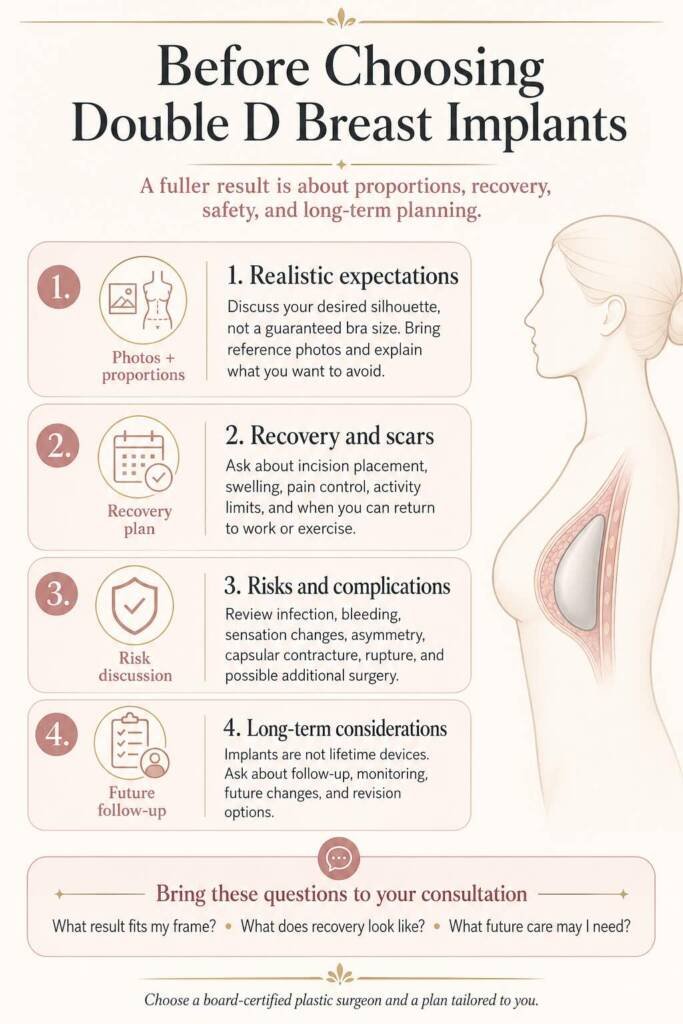
Ask how the proposed implant may change your silhouette, rather than asking for a guaranteed bra size. Bring examples of shapes you like and explain what you do not want, such as excessive upper fullness or a wide side contour.
Scarring, recovery, and potential complications
Discuss incision location, expected swelling, activity restrictions, pain management, and the timeline for returning to work or exercise. Potential complications can include infection, bleeding, changes in sensation, asymmetry, capsular contracture, implant rupture, or the need for additional surgery. Your surgeon should explain which risks apply to your circumstances and how they are managed.
Revision surgery and long-term implant considerations
Breast implants are not generally considered lifetime devices, and future surgery may become necessary because of complications, aging, tissue changes, or a change in preference. Ask how follow-up is handled and what signs should prompt a call. Dr. K Miami Plastic Surgery emphasizes patient support from the initial consultation through final follow-up, a helpful standard to clarify before scheduling.
Questions to ask during a consultation
A written list can keep the appointment focused, especially when several implant options seem similar. Consider asking:
- Which implant dimensions fit my breast and chest measurements?
- What range of cup-size change is realistic for my starting anatomy?
- Which placement and profile do you recommend, and why?
- What recovery limits, follow-up visits, and long-term considerations should I expect?
These questions invite a personalized explanation rather than a simple volume recommendation. They also help you understand how the proposed plan supports comfort, safety, and the look you want.
Conclusion
Double D breast implants do not come in one standard size, and a cup label cannot replace an individualized plan. Implant volume, profile, shape, placement, natural tissue, and body proportions all influence the result. The most useful next step is an honest consultation focused on anatomy, realistic expectations, and the kind of fullness that feels right for your body.
Frequently Asked Questions
What size implants are considered double D?
There is no universal implant size for a DD result. The required volume varies with starting breast tissue, band size, chest width, implant dimensions, and the amount of fullness desired.
How many cc are double D breast implants?
A DD appearance may be associated with many different implant volumes, often within the broad range of several hundred cc, but no fixed number applies to every patient. Measurements and implant shape matter as much as volume.
Is a DD cup larger than a D cup?
In many bra-sizing systems, DD is one cup step larger than D. However, bra labels vary, so the visual difference is not identical across brands or band sizes.
Can implants guarantee a specific bra cup size?
No. Implants can increase breast volume, but the final bra size also depends on natural tissue, chest and band measurements, swelling, healing, and the design of the bra.
Do round implants always look less natural?
Not necessarily. The appearance of round implants depends on their profile, placement, size, and the patient’s existing tissue. A properly selected implant can look balanced on many different body types.
How long does recovery from breast augmentation take?
Early recovery often involves swelling, soreness, and limits on strenuous activity. The precise timeline varies by procedure, implant placement, health, and the surgeon’s instructions, while the final shape may continue settling for months.
Can breast implants change after pregnancy or weight loss?
Yes. Pregnancy, breastfeeding, weight changes, and aging can alter the surrounding breast tissue and skin even if the implants remain intact. Future changes may affect shape, symmetry, or the need for revision.