

A breast lift can take years off your appearance in a single afternoon, but the weeks that follow determine how well those results hold. Most patients return to normal activities within 6 weeks, though the timeline varies based on your body’s healing response and how closely you follow post-operative care instructions.
This guide walks you through the recovery process day by day, covers pain management and activity restrictions, and explains when to contact your surgeon versus when symptoms are completely normal.
What Breast Lift Recovery Involves
Breast lift recovery typically involves 1 to 2 weeks of initial downtime followed by about 6 weeks of activity restrictions. You can expect soreness, swelling, and bruising that peak during the first week, then gradually fade. Most patients wear a surgical bra around the clock, sleep on their back, and avoid lifting anything over 10 pounds during the early healing phase.
The medical term for a breast lift is mastopexy, the fourth most popular cosmetic surgery, and the recovery process follows a fairly predictable path. Your body is working to heal repositioned breast tissue, internal sutures, and external incisions all at once. Knowing what to expect makes the whole experience feel more manageable.
- Downtime: 7 to 14 days away from work and daily responsibilities
- Activity restrictions: No upper body exercise or heavy lifting for approximately 6 weeks
- Common symptoms: Chest tightness, tenderness around incision sites, and
temporary changes in nipple sensationtemporary changes in nipple sensation - Essential requirements: Front-closure surgical bra, elevated sleeping position, and someone to help you at home for the first few days
Breast Lift Recovery Timeline Week by Week
Every patient heals at a slightly different pace, though the general progression tends to look similar across the board. Your surgeon’s specific instructions always take priority over any general timeline.
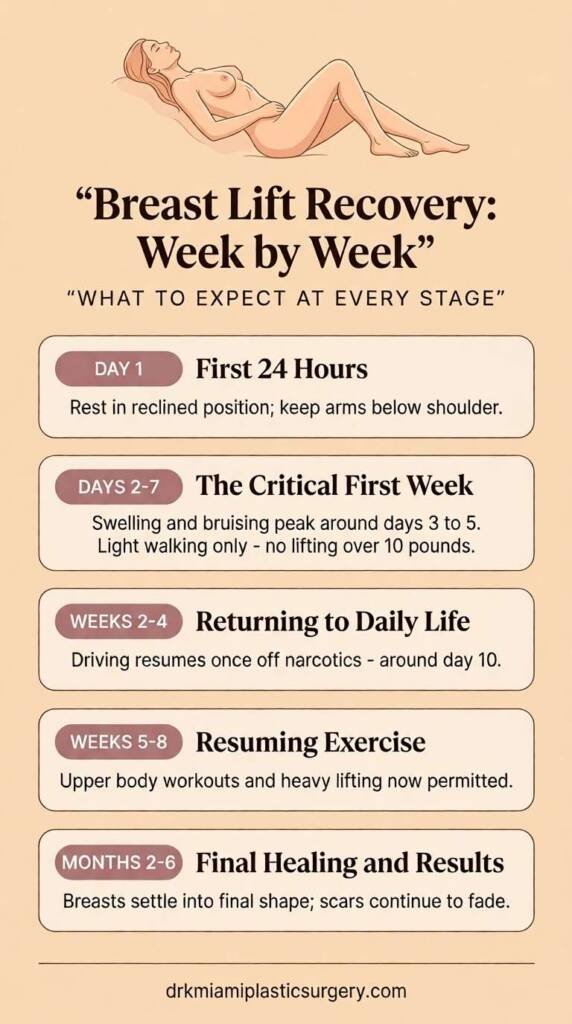
Day 1 First 24 Hours After Surgery
You’ll wake up feeling groggy from anesthesia, and mild to moderate discomfort is completely normal. Prescription pain medication keeps things comfortable during this initial window.
Keep your arms below shoulder level and avoid any reaching or lifting. Most patients spend this day resting in a reclined position, getting up only for bathroom trips and short walks around the room to keep blood flowing.
Days 2 to 7 The Critical First Week
Swelling and bruising hit their peak around days 3 to 5, then start to ease up. Your chest may feel tight, almost like wearing a sports bra that’s a size too small. This sensation is temporary and fades as healing progresses.
Light walking around your home helps circulation and lowers the risk of blood clots. At the same time, avoid bending at the waist, straining, and lifting anything heavier than a gallon of milk. By the end of the week, many patients feel well enough to handle desk work or light tasks.
Weeks 2 to 4 Returning to Daily Life
Pain mostly fades during this stretch, replaced by occasional twinges and lingering tightness. Your surgeon typically removes any external stitches at a follow-up appointment around the 2-week mark.
Once you’re off narcotic pain medication and can turn your body comfortably, driving becomes an option again. Daily activities like light cooking, gentle housework, and short outings start to feel manageable.
Weeks 5 to 8 Resuming Exercise and Lifting
Most restrictions lift during this window. You can gradually return to full workouts, including upper body exercises, though starting at about half your usual intensity is a good approach.
Side sleeping becomes comfortable again, and lifting heavier objects like groceries, children, or gym weights is typically permitted with your surgeon’s clearance. Some days will feel better than others, so listening to your body matters.
Months 2 to 6 Final Healing and Results
Your breasts continue settling into their final position during this phase. Some patients and surgeons call this process “drop and fluff,” where the lifted shape softens and looks increasingly natural over time.
Scars fade from pink or red to lighter tones, though complete scar maturation takes 12 to 18 months. Maintaining a stable weight and following a consistent scar care routine helps preserve your results.
How Painful Is Breast Lift Recovery
Pain is one of the most common concerns, yet most patients describe the discomfort as manageable rather than severe. The sensation feels like deep muscle soreness combined with tightness across the chest.
- Immediately after surgery: Grogginess from anesthesia masks much of the discomfort, and prescription medication handles the rest
- First few days: Peak discomfort occurs around days 2 to 4, often described as a 4 to 6 on a 10-point scale
- After the first week: Most patients transition to over-the-counter pain relievers like acetaminophen or ibuprofen
- Pain management options: Prescription opioids for the first few days, then OTC medication as directed by your surgeon
The pulling or tugging sensation around your incisions can feel strange, but it signals that your tissues are healing properly. If pain suddenly worsens after initially improving, contact your surgeon right away since this could indicate a complication.
Activity Restrictions and Return to Work After a Breast Lift
Restrictions exist to protect your incisions, prevent bleeding, and help your lifted breast tissue heal in the correct position. Pushing too hard too soon can compromise your results.
| Activity | When You Can Resume |
|---|---|
| Desk work | 5 to 7 days |
| Driving | 1 to 2 weeks (once off narcotics) |
| Light exercise | 3 to 4 weeks |
| Full workouts | 6 to 8 weeks |
| Heavy lifting | 6 to 8 weeks |
Driving After a Breast Lift
You can drive once you’re off prescription pain medication and can turn your torso comfortably to check blind spots. For most patients, this happens around 10 to 14 days after surgery.
Lifting and Bending
Avoid lifting anything over 10 pounds for the first 4 to 6 weeks. Overhead reaching stretches healing tissue and can widen scars, so keeping your elbows below shoulder height during the early weeks helps protect your results.
Best Sleeping Positions
Back sleeping in an elevated position, using a wedge pillow or 2 to 3 stacked pillows, reduces swelling and protects your results. Side and stomach sleeping put pressure on healing breast tissue and can be quite painful in the early weeks.
Most patients can return to side sleeping around week 6, though stomach sleeping may remain uncomfortable for several months.
Exercise and Strenuous Activity
Light walking is encouraged from day one since it boosts circulation without straining your chest. Upper body workouts, running, and high-impact activities wait until the 6 to 8 week mark.
When you do return to exercise, starting at about 50% of your usual intensity and gradually increasing over 2 to 3 weeks gives your body time to adjust.
Scar Care and Incision Healing After a Breast Lift
Incision patterns vary based on how much lift you need. The anchor incision runs around the areola, vertically down, and along the breast crease, addressing significant sagging. The lollipop pattern runs around the areola and vertically down, working well for moderate cases.
- Initial healing: Keep incisions clean and dry, and avoid submerging in water for 3 to 4 weeks
- After incisions close: Begin scar treatment once your surgeon confirms the incisions are fully sealed
- Silicone products: Silicone gel sheets or topical silicone gel
can flatten and fade scars over time, the recommended first-line option for scar management, can flatten and fade scars over time - Scar massage: Gentle circular massage with clean fingers helps break down scar tissue
- Sun protection: UV exposure darkens scars permanently, so using SPF 30+ or keeping scars covered for the first year is helpful
Scars appear most prominent at 2 to 3 months, then gradually fade over 12 to 18 months. Final scar appearance depends on your skin type, genetics, and how consistently you follow scar care protocols. In cases where scars remain raised or discolored beyond typical maturation, scar revision can improve their appearance.
Warning Signs and Complications After a Breast Lift
Knowing the difference between normal healing and a potential problem helps you respond appropriately. Most complications are rare when you follow post-operative instructions carefully.
Signs of Infection
Contact your surgeon if you notice fever above 101°F, increasing redness spreading from the incision, pus or foul-smelling discharge, or unusual warmth around the surgical site. Caught early, infections respond well to antibiotics.
Hematoma and Excessive Swelling
A hematoma is a collection of blood under the skin that causes sudden asymmetric swelling, firmness, and increased pain on one side. This complication typically requires drainage and usually occurs within the first 24 to 48 hours.
Fat Necrosis and Delayed Healing
Fat necrosis happens when fatty tissue doesn’t receive adequate blood supply and forms firm lumps under the skin. These lumps usually appear several weeks after surgery and may resolve on their own or require minor intervention.
Tips to Speed Up Breast Lift Recovery
A few evidence-based practices support optimal healing and help you return to normal life as quickly as possible.
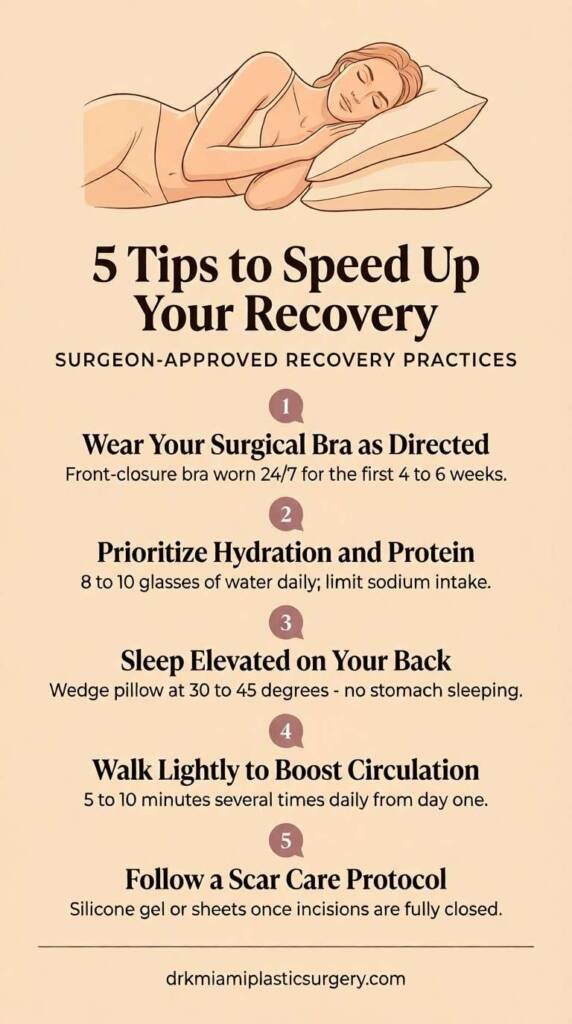
1. Wear Your Surgical Bra as Directed
Front-closure surgical bras allow you to dress without raising your arms. Consistent support stabilizes healing tissue and reduces swelling, and most surgeons recommend wearing the bra 24/7 for the first 4 to 6 weeks.
2. Prioritize Hydration and Protein-Rich Nutrition
Aim for 8 to 10 glasses of water daily and emphasize lean proteins, fruits, and vegetables. Limiting sodium intake helps reduce swelling since excess salt causes your body to retain fluid.
3. Sleep Elevated and Avoid Stomach Sleeping
A wedge pillow or 2 to 3 stacked pillows keeps your upper body at a 30 to 45 degree angle. This position minimizes swelling and prevents you from rolling onto your stomach during sleep.
4. Walk Lightly to Boost Circulation
Short walks around your home, even 5 to 10 minutes several times daily, promote blood flow and reduce the risk of blood clots without straining your incisions.
5. Follow a Surgeon-Approved Scar Care Protocol
Wait until your incisions are fully closed before starting scar treatment. Silicone-based products and gentle massage, used consistently for several months, tend to produce the best long-term scar appearance.
Cost of Breast Lift Aftercare and Recovery Essentials
Recovery supplies represent a separate investment from your procedure cost. Budget approximately $150 to $400 for a complete recovery kit, depending on product quality and quantity.
- Front-closure surgical bras: $30 to $60 each, and planning for 2 to 3 allows for rotation
- Compression or support bras: $40 to $80 for wire-free, high-support options
- Wedge pillow: $40 to $80 for a quality foam wedge
- Ice packs: $15 to $30 for gel packs with protective covers
- Scar treatment products: $30 to $100 for silicone sheets or medical-grade silicone gel
Recovering From a Combined Breast Lift and Augmentation
Many patients choose to combine a breast lift with implants for enhanced volume and projection. This combination extends recovery slightly because your body is healing both repositioned tissue and an implant pocket.
Expect more swelling initially and a longer augmentation recovery period before implants settle into their final position, typically 3 to 6 months. Your surgeon provides specific instructions for combination procedures, which may differ from lift-only recovery protocols.
Plan Your Breast Lift Recovery With Dr. K Miami Plastic Surgery
Dr. Bart Kachniarz takes a personalized approach to recovery, tailoring post-operative protocols to your specific procedure, lifestyle, and healing patterns. From your first consultation through your final follow-up, the focus remains on your safety, comfort, and confidence.
For out-of-town patients traveling to Miami, the practice coordinates seamless logistics so you can focus entirely on healing.
Frequently Asked Questions About Breast Lift Recovery
What do I wish I knew before getting a breast lift?
Most patients wish they had prepared for surgery more thoroughly—arranging help at home for the first week and setting up a comfortable recovery station with all supplies within arm’s reach.
Will I lose nipple sensation after a breast lift?
Temporary numbness or heightened sensitivity is common in the weeks following surgery. Most patients experience a return to normal sensation within 3 to 6 months, though permanent changes occur in a small percentage of cases.
What foods should I avoid during breast lift recovery?
Limiting sodium, alcohol, and heavily processed foods during the first several weeks helps reduce swelling and supports your body’s natural healing processes.
Can I breastfeed after a breast lift?
Breastfeeding may still be possible depending on the surgical technique used and whether milk ducts were affected. Discussing future breastfeeding plans with your surgeon before the procedure allows the approach to be tailored accordingly.
When can I fly home after a breast lift in Miami?
Most out-of-town patients are cleared to fly after surgery within 7 to 14 days, though your surgeon confirms the timing based on your individual healing progress and the length of your flight.