

Body contouring procedures reshape your silhouette by removing stubborn fat and excess skin that won’t respond to diet or exercise alone. Whether you’ve lost significant weight or simply want to refine specific areas, these surgical and non-surgical options offer targeted solutions—from liposuction and tummy tucks to non-invasive treatments like CoolSculpting.
This guide covers the 10 most effective body contouring procedures available today, along with what to expect for recovery, costs, and how to determine which approach fits your goals.
What is body contouring
Body contouring reshapes your silhouette by removing excess fat and sagging skin—typically after major weight loss or to target stubborn areas that won’t budge with diet and exercise. The American Society of Plastic Surgeons reports that body contouring procedures rank among the top five most requested cosmetic categories in the United States, with surgical options ranging from $3,000 to $15,000 or more depending on the procedure.
Here’s the key distinction: body contouring isn’t weight loss. You’ve already done the hard work of losing weight or staying fit. Body contouring is the finishing step—refining specific areas where skin has lost elasticity or fat deposits remain despite your best efforts.
Both surgical and non-surgical paths exist. Surgical procedures deliver dramatic, visible results in one session. Non-surgical options work gradually over weeks or months with little to no downtime. Which route makes sense depends entirely on your goals, your anatomy, and how much recovery time you can realistically take.
Surgical vs non-surgical body contouring
Surgical body contouring removes fat and skin through incisions, producing significant changes you’ll notice immediately once swelling subsides. Non-surgical methods use energy-based technologies—cold, heat, lasers, or radiofrequency—to destroy fat cells or tighten skin without cutting.
The trade-off is straightforward: surgery offers more dramatic results but requires real recovery time. Non-surgical treatments—which accounted for over 20.5 million procedures globally in 2024—fit easily into a busy schedule but produce subtler improvements.
| Factor | Surgical | Non-Surgical |
|---|---|---|
| Results | Dramatic, immediate | Gradual, subtle |
| Downtime | 2–6 weeks | Minimal to none |
| Anesthesia | General or sedation | None or topical |
| Best for | Significant loose skin or fat | Small fat pockets, mild laxity |
| Sessions | Usually one | Multiple treatments |
If you have substantial loose skin after losing 50 or 100 pounds, surgical options are typically the only effective solution. However, if you’re dealing with a small pocket of fat on your flanks and your skin still has good elasticity, a non-surgical treatment might deliver exactly what you’re looking for.
The 10 best body contouring procedures
1. Liposuction
Liposuction is the most commonly performed body contouring procedure in the world. A thin tube called a cannula is inserted through small incisions to suction out fat deposits from targeted areas.
The procedure works well for the abdomen, flanks (love handles), thighs, arms, back, and under the chin.
One important note: liposuction removes fat but doesn’t tighten loose skin. If your skin has good elasticity, it will contract nicely after the fat is removed. If not, you may want to combine liposuction with a lift procedure.
Recovery typically involves one to two weeks of limited activity. You’ll wear compression garments for several weeks to minimize swelling and help your skin conform to your new contours.
2. Tummy tuck
A tummy tuck—formally called abdominoplasty—removes excess abdominal skin and tightens the underlying muscle wall. This procedure is particularly valuable for women after pregnancy, when stretched abdominal muscles and skin often don’t bounce back on their own.
Unlike liposuction, a tummy tuck directly addresses skin laxity. Many patients combine both: liposuction to remove stubborn fat and abdominoplasty to tighten everything up.
Plan for two to four weeks before returning to desk work and six to eight weeks before resuming strenuous exercise.
3. Brazilian butt lift
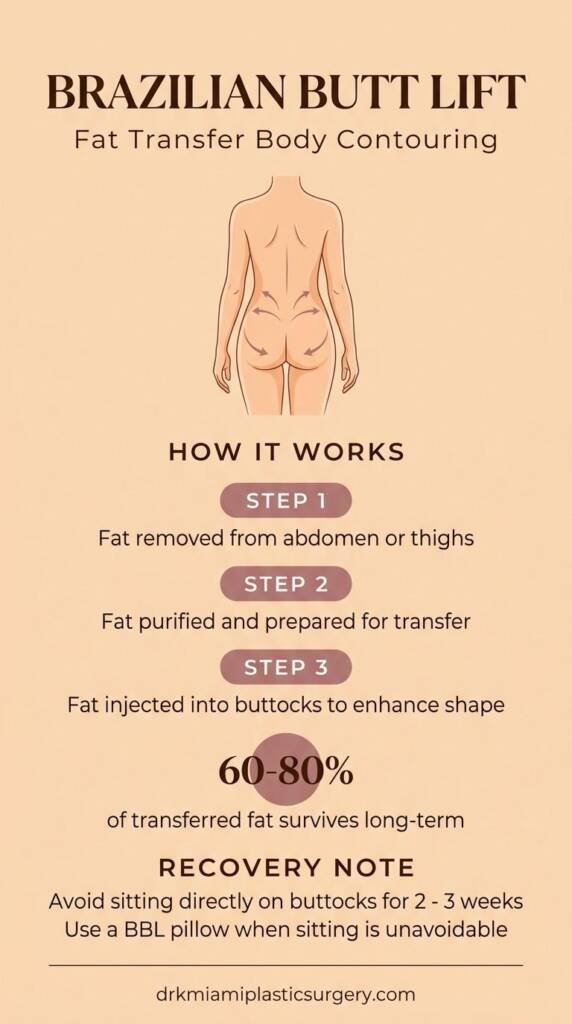
The Brazilian butt lift (BBL) combines liposuction with fat transfer. Your surgeon removes fat from areas like your abdomen or thighs, purifies it, then strategically injects it into your buttocks to enhance shape and projection.
This two-in-one approach slims donor areas while augmenting your buttocks using your own tissue—no implants involved. The natural feel and dual benefit have made BBL the fastest-growing aesthetic surgical procedure globally.
- Recovery consideration: Avoid sitting directly on your buttocks for approximately two to three weeks
- Special equipment: You’ll use a BBL pillow when sitting is unavoidable
- Fat survival: Typically 60–80% of transferred fat survives long-term
4. Lower body lift
A lower body lift, also called belt lipectomy, addresses your entire lower trunk in one circumferential procedure. It targets the buttocks, hips, outer thighs, and abdomen simultaneously.
This comprehensive approach is typically reserved for patients after massive weight loss—often 100 pounds or more—who have significant skin excess wrapping around their entire midsection. The procedure essentially lifts and tightens your lower body as a unit.
Given the scope, recovery is more extensive. Expect three to four weeks before returning to light activities and longer before resuming exercise.
5. Arm lift
Brachioplasty removes excess skin and fat from the upper arms, correcting the “bat wing” appearance that often develops with age or after significant weight loss. The incision typically runs along the inner arm from the armpit toward the elbow.
The resulting scar is a consideration, though it’s usually well-hidden along the inner arm and fades considerably over time. For patients with only mild excess fat and good skin tone, liposuction alone may be sufficient.
Most patients return to normal activities within two weeks. Arm elevation and compression sleeves help minimize swelling during recovery.
6. Thigh lift
A thigh lift reshapes the inner or outer thighs by removing excess skin and fat. Medial (inner) thigh lifts are more common, targeting the skin laxity that often occurs after weight loss.
The procedure can dramatically improve comfort for patients whose excess thigh skin causes chafing or limits clothing options. Incisions are typically placed in the groin crease where underwear conceals them.
Recovery involves limited walking for the first week or two, with gradual return to full activity over four to six weeks.
7. Mommy makeover
A mommy makeover isn’t a single procedure—it’s a customized combination performed in one surgical session. The typical combination includes a tummy tuck, breast surgery (lift, augmentation, or reduction), and liposuction.
This approach addresses multiple areas affected by pregnancy and breastfeeding simultaneously. The advantage is efficiency: one recovery period instead of several separate surgeries spaced months apart.
While recovery is more involved than a single procedure, many women find addressing everything at once worth the extended downtime of three to four weeks.
8. CoolSculpting
CoolSculpting uses cryolipolysis—controlled cooling that freezes and destroys fat cells without damaging surrounding tissue. Your body then naturally eliminates the dead cells over the following weeks and months.
This FDA-cleared treatment works best for small, pinchable fat pockets in patients already near their ideal weight. It’s not designed for significant fat reduction or loose skin.
- Treatment time: 35–60 minutes per area
- Sessions typically needed: 1–3 per area
- Results visible: 2–3 months after treatment
- Downtime: None
9. Radiofrequency skin tightening
Radiofrequency (RF) treatments deliver heat energy to deep skin layers, stimulating collagen production and gradually tightening skin over time. Brand names include Thermage, Morpheus8, and Venus Legacy.
Results are subtle and develop over several months as new collagen forms. Multiple sessions—typically three to six—are usually recommended for optimal improvement.
RF works well for patients with mild skin laxity who want improvement without surgery. However, it cannot replicate the dramatic tightening that surgical procedures achieve.
10. Emsculpt NEO
Emsculpt NEO combines radiofrequency with high-intensity focused electromagnetic energy (HIFEM) to simultaneously reduce fat and build muscle. A single 30-minute session induces approximately 20,000 muscle contractions—far more than you could achieve through exercise alone.
This FDA-cleared treatment requires no anesthesia and has zero downtime. It’s particularly popular for abdominal definition and buttock lifting.
While Emsculpt NEO complements rather than replaces surgical options, it offers a unique approach for patients seeking both fat reduction and muscle definition without any incisions.
Who is a good candidate for body contouring
The ideal body contouring candidate has reached a stable weight and maintained it for several months. Body contouring procedures refine your shape—they’re not weight loss solutions.
Good overall health matters significantly because it affects both surgical safety and healing. Non-smokers heal better and have lower complication rates. If you smoke, plan to quit at least four weeks before any surgical procedure.
- Stable weight: Consistent for at least three to six months
- Specific concerns: Fat deposits or loose skin that don’t respond to diet and exercise
- Good health: No conditions that impair healing
- Realistic expectations: Clear understanding of what procedures can and cannot achieve
Perhaps most importantly, realistic expectations lead to the highest satisfaction. A consultation helps clarify what’s achievable for your specific anatomy and goals.
Body contouring recovery timeline
Recovery varies significantly between surgical and non-surgical options. Non-surgical treatments typically involve no downtime—you can return to normal activities immediately, though treated areas may feel tender or appear swollen temporarily.
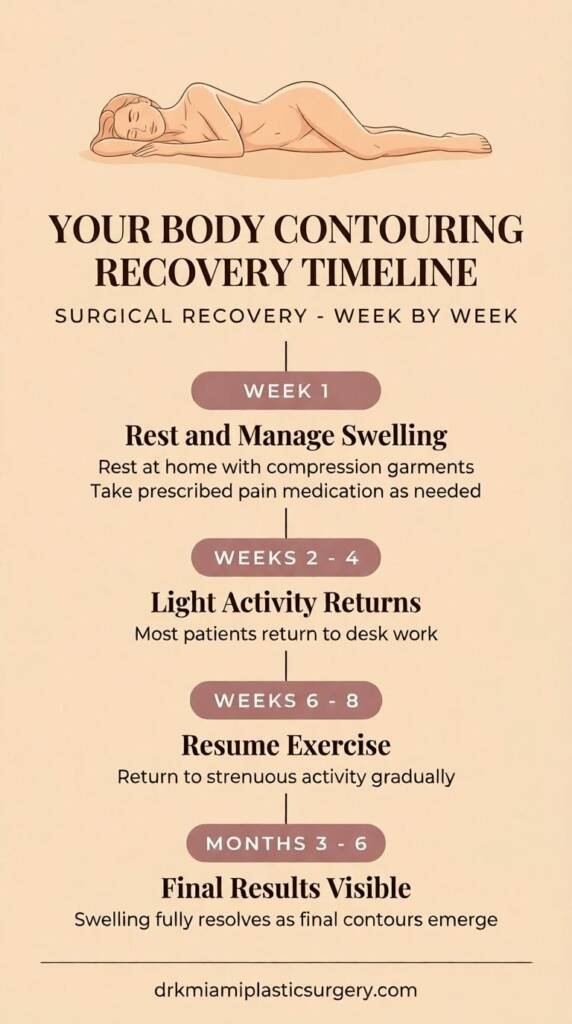
Surgical recovery follows a more predictable pattern, though individual experiences vary based on the procedure’s extent and your body’s healing response.
- First week: Rest at home, manage swelling with compression garments, take prescribed pain medication as needed
- Weeks 2–4: Light activity resumes, most patients return to desk work
- Weeks 6–8: Resume exercise and more strenuous activity
- Months 3–6: Final results become visible as swelling fully resolves
Following your surgeon’s post-operative instructions—especially regarding compression garments, activity restrictions, and follow-up appointments—directly impacts both your results and recovery speed.
Risks and safety considerations for body contouring
All surgical procedures carry inherent risks. Choosing a board-certified plastic surgeon with specific experience in body contouring significantly reduces complication rates.
Surgical risks include:
- Infection
- Bleeding
- Scarring
- Seroma (fluid accumulation under the skin)
- Changes in sensation
- Anesthesia-related complications
Non-surgical risks are typically mild and temporary:
- Redness or bruising in treated areas
- Swelling
- Temporary numbness
For fat transfer procedures like BBL, fat necrosis—where some transferred fat cells don’t survive—is a specific consideration. Your surgeon’s technique and experience directly influence this outcome.
How much body contouring costs in Miami
Body contouring costs vary based on procedure complexity, number of areas treated, anesthesia requirements, and surgeon expertise. Non-surgical options generally cost less per session but often require multiple treatments to achieve desired results.
Factors that influence pricing:
- Procedure complexity: More extensive procedures require more operating time
- Anesthesia and facility fees: Included in surgical pricing
- Number of areas treated: Multiple areas increase total cost
- Surgeon experience: Board-certified specialists with specialized training typically charge more
Most practices offer financing options to make procedures more accessible. You can review our plastic surgery price list for general ranges, and a consultation provides a personalized quote based on your specific goals and treatment plan.
How to choose the right body contouring procedure
Start by identifying your primary concern. Excess skin after weight loss typically requires surgical lift procedures—no amount of non-surgical treatment can remove significant loose skin.
Stubborn fat pockets with good overlying skin tone respond well to either liposuction or non-surgical fat reduction, depending on the volume involved and your tolerance for downtime.
- Excess skin after weight loss: Surgical lift procedures (tummy tuck, arm lift, thigh lift, body lift)
- Stubborn fat with good skin tone: Liposuction or CoolSculpting
- Mild skin laxity: Radiofrequency treatments or combination approaches
- Multiple concerns: Combination procedures or a staged approach over time
A consultation allows your surgeon to examine your specific anatomy, discuss your goals, and recommend the approach most likely to achieve the results you’re envisioning.
Start your body contouring consultation in Miami
Every body contouring journey begins with understanding your options. At Dr. K Miami Plastic Surgery, consultations focus on your individual goals—examining your specific concerns and creating a tailored treatment plan that fits your life.
Whether you’re considering a single procedure or a more comprehensive transformation, the right approach depends on factors unique to you: your anatomy, your lifestyle, the recovery time you can accommodate, and your aesthetic vision.
Frequently asked questions about body contouring procedures
What is the difference between body sculpting and body contouring?
Body sculpting and body contouring are often used interchangeably. Both terms refer to procedures that reshape the body by targeting fat and skin. Some practitioners use “body sculpting” specifically for non-surgical fat reduction treatments, while “body contouring” may encompass both surgical and non-surgical options. In practice, the distinction is more about marketing than medical terminology.
Is body contouring surgery painful?
Surgical body contouring is performed under anesthesia, so you feel nothing during the procedure itself. Post-operative discomfort is managed with prescribed pain medication and typically improves significantly within the first week. Most patients describe the sensation as soreness and tightness rather than sharp pain.
How long do body contouring results last?
Results from surgical procedures are considered permanent as long as you maintain a stable weight. Fat cells removed through liposuction don’t regenerate, and skin removed during lift procedures is gone permanently. However, significant weight gain can compromise results by expanding remaining fat cells or stretching skin again.
Can you combine multiple body contouring procedures in one surgery?
Yes, combining procedures is common and often advantageous. A tummy tuck with liposuction, a BBL and tummy tuck combination, or a full mommy makeover combining several procedures, reduces overall recovery time compared to separate surgeries. Your surgeon will assess whether combining procedures is safe based on total surgical time and your health status.
How much weight do you lose before body contouring?
Reach and maintain your goal weight for at least three to six months before body contouring. Significant weight fluctuations after surgery can compromise your results—weight gain stretches skin and expands remaining fat cells, while further weight loss can create new areas of loose skin that weren’t addressed during your procedure.