

Key Takeaways
The biggest size of breast implants you can have is determined by your anatomy, tissue quality, goals, and what your surgeon considers safe—not by a single universal number.
- Implant volume is measured in cubic centimeters, not bra cup sizes.
- Chest width, tissue coverage, skin elasticity, and body proportions limit implant size.
- Profile changes projection and appearance, even when two implants have the same volume.
- Very large implants may increase discomfort, tissue stretching, visibility, and revision risk.
- A consultation with a board-certified plastic surgeon is essential for individualized planning.
How breast implant size is measured
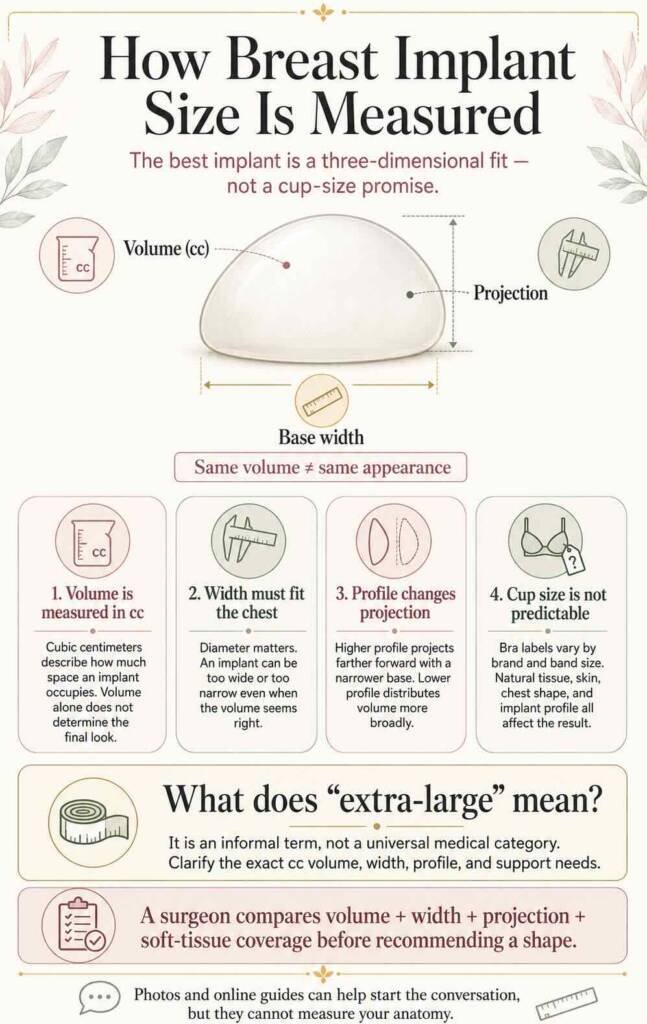
Breast implant size can sound confusing because patients often think in terms of cup sizes, while surgeons and manufacturers use volume and dimensions. The same volume may look quite different depending on its width, projection, shape, and the patient’s existing breast tissue. Thinking about size as a three-dimensional fit makes the decision more practical. It also helps explain why a particular implant may be too wide or too prominent even when its volume seems appealing.
Why implant volume is listed in cubic centimeters
Implant volume is usually listed in cubic centimeters, abbreviated as cc. A cc describes the amount of space an implant occupies, giving the surgical team a more precise measurement than a vague description such as “large.” Volume is only one part of the selection, however; the implant’s diameter and projection matter just as much when it must fit a specific chest.
A consultation at Dr. K Miami Plastic Surgery can place that number in the context of your individual anatomy and desired result. The goal is not simply to identify the largest available volume, but to understand which dimensions can be supported comfortably.
How implant volume differs from bra cup size
Bra cup sizes are not standardized across brands, and they also depend on band size and bra design. An implant does not translate predictably into a particular cup size because the final appearance includes your natural breast tissue, chest shape, skin, and implant profile. For that reason, a surgeon may discuss a range of volumes rather than promise a specific cup-size change.
People researching size ranges may find a breast implant size guide useful as general background, but it should not replace an in-person evaluation. Photos and online calculators can suggest a direction; they cannot measure your soft-tissue limits.
What “extra-large” breast implants typically mean
“Extra-large” is an informal term rather than a universal medical category. Some practices use it for implants above roughly 600 cc, while others reserve the description for volumes above 800 cc or much higher. The phrase therefore needs clarification during consultation, including the exact volume, width, profile, and whether more than one operation may be involved.
Very large options can create a dramatic change, but they are not suitable for every frame. A larger volume may require adequate tissue coverage, careful support, and a realistic discussion about future maintenance.
How implant profile affects the final appearance
Profile describes how far an implant projects forward relative to its base width. A high-profile implant can provide more projection with a narrower base, while a lower profile generally spreads volume over a wider footprint. Two implants with the same cc volume may therefore produce noticeably different contours.
The profile should match your chest width and the look you want, rather than being chosen because it sounds more dramatic. Your surgeon can compare width, projection, and soft-tissue coverage together before recommending a shape.
What determines the biggest size you can have
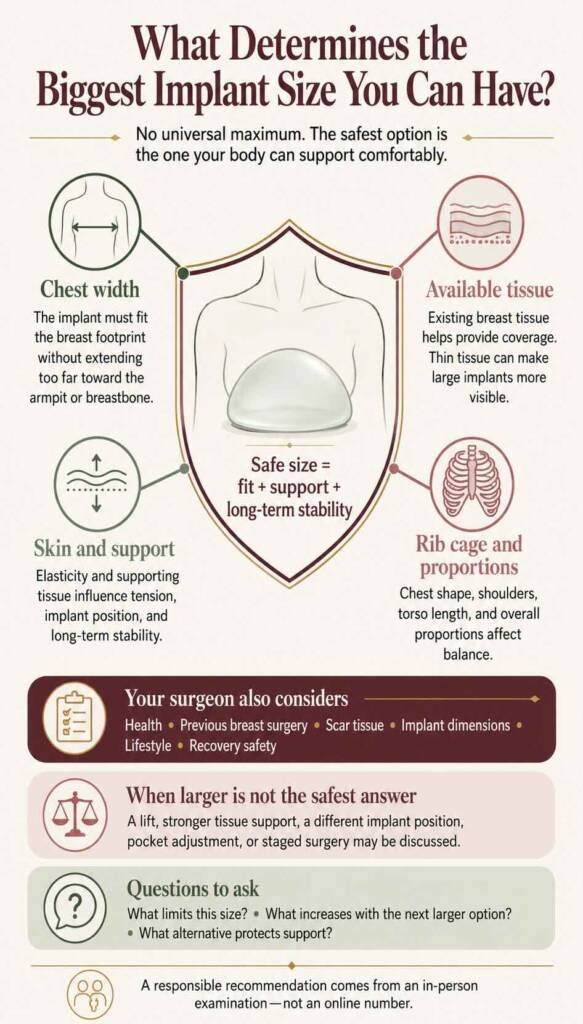
There is no single maximum breast implant size that applies to everyone. The biggest size of breast implants you can have depends on whether your chest and soft tissues can accommodate the implant without excessive tension or an unstable result. A surgeon also considers your health, previous operations, lifestyle, and willingness to accept additional trade-offs. The safest answer comes from measurements and examination, not from an online number.
Chest width and available breast tissue
The width of your breast base is one of the first practical limits. An implant that extends too far toward the armpit or breastbone may look unnatural, feel uncomfortable, or place pressure on surrounding tissue. Existing breast volume can provide additional coverage, while a very thin tissue layer may make a large implant more visible.
Your surgeon measures the breast footprint and chest wall before discussing volume. Those measurements help narrow the choices to implants that can sit within a reasonable boundary.
Skin elasticity and soft-tissue coverage
Skin and supporting tissue must stretch around the implant and help hold it in position. If the skin is thin or already lax, a large implant may create more tension and make the edges easier to see or feel. Pregnancy, weight changes, aging, and prior augmentation can all affect tissue behavior.
A natural-looking result is not guaranteed simply by placing more volume beneath the skin. Sometimes the tissue needs more support, a different implant position, or a lift instead of a larger implant alone.
Rib cage shape and body proportions
The shape of your rib cage affects how an implant rests on the chest. A narrow rib cage may have less room for width, while a broader chest may accommodate a wider base more comfortably. Shoulder width, torso length, and overall proportions also influence whether a very large augmentation appears balanced.
These details explain why a size that looks appropriate in one person may overwhelm another. Personalized planning is central to the approach described by Dr. K Miami Plastic Surgery, which emphasizes natural, individualized outcomes and patient support.
Existing breast implants or previous breast surgery
A previous augmentation, breast lift, reduction, reconstruction, or significant scarring can change the available space and the strength of the breast envelope. Revision surgery may involve removing an old implant, adjusting the pocket, treating scar tissue, or improving coverage before considering a larger size.
The implant currently in place is also relevant. Simply increasing volume may not correct stretching, displacement, asymmetry, or weakened support, so the full condition of the breast must be assessed first.
Your surgeon’s assessment and safety limits
A surgeon’s recommendation reflects more than aesthetic preference. It includes your examination, medical history, tissue quality, implant dimensions, surgical technique, and ability to recover safely. A responsible surgeon may decline a requested size if the predicted tension or long-term burden is too high.
That conversation should feel collaborative rather than dismissive. You can ask what limits the proposed size, what alternatives exist, and which risks would increase if you chose the next larger option.
How surgeons choose a suitable implant size
Choosing an implant is a process of matching your goals to your anatomy. Surgeons look at the breast base, tissue thickness, skin quality, nipple position, chest wall, and desired degree of fullness. They may also consider clothing, exercise, work, and whether you want a subtle or unmistakably augmented appearance. The best plan is often a range of acceptable options rather than one number selected in isolation.
Using measurements rather than cup-size goals
Measurements give the surgeon a repeatable starting point. Breast width, tissue thickness, distance between the breasts, and the amount of natural tissue help establish boundaries for implant diameter and projection. A cup-size goal can still communicate your preference, but it cannot define the surgical plan on its own.
Bring photographs that show the shape and fullness you like, while remembering that a reference image reflects another person’s anatomy. Your surgeon can explain which aspects may be realistic for you and which may not.
Trying implant sizers and using 3D imaging
External sizers placed inside a bra can help you experience how different volumes affect clothing and movement. Some practices also offer 3D imaging to preview potential contours. These tools are useful for communication, but they are estimates rather than promises of the final result.
Try to assess more than the front view. Notice how the proposed size feels under clothing, changes your posture, and fits with the lifestyle you expect after recovery.
Comparing implant width, projection, and profile
A surgeon may show several implants with similar volumes but different profiles. One may be wider and flatter, while another projects more with a narrower base. The comparison helps identify whether your preference is really about total volume, upper-pole fullness, cleavage, or forward projection.
The following framework can make that discussion easier:
| Implant feature | What it describes | Why it matters |
|---|---|---|
| Volume | The amount of fill, measured in cc | Influences overall fullness |
| Width | The implant’s base diameter | Must fit the breast and chest |
| Projection | How far the implant extends forward | Affects profile and prominence |
| Profile | The relationship between width and projection | Helps shape the final contour |
After reviewing these differences, you may find that a narrower, higher-profile implant meets your aesthetic goal without the same volume as a wider implant. The decision should follow the fit, not just the largest figure on the chart.
Balancing your desired look with natural proportions
Some patients want a pronounced, glamorous silhouette; others want a fuller but understated result. Neither preference is inherently right or wrong. The surgical plan should respect your goals while accounting for the proportions of your chest, shoulders, waist, and existing breast tissue.
At Dr. K Miami Plastic Surgery, the stated focus on a holistic approach and personalized outcomes aligns with discussing the whole patient rather than treating implant volume as the only objective. Your preferences deserve a clear conversation about what the operation can and cannot achieve.
Why the largest possible implant may not be the best choice
A very large implant can produce an immediate dramatic change, but the long-term result may be less satisfying if the skin stretches, the implant becomes visible, or daily activities become uncomfortable. A slightly smaller implant may preserve better tissue support and fit more naturally with your frame.
Ask your surgeon to compare your preferred size with a conservative alternative. Seeing the likely trade-offs side by side often makes the decision less emotional and more grounded.
Risks of choosing very large breast implants
Larger implants place greater demands on the breast skin, connective tissue, and supporting structures. Some people accept those trade-offs for a particular aesthetic goal, but the risks should be discussed before surgery rather than after problems appear. Recovery may also be more involved, especially when a lift or staged approach is needed. Understanding the possible costs—physical, practical, and financial—helps you consent thoughtfully.
Stretching of the skin and breast tissue
A large implant can stretch the skin and breast tissue over time. This may contribute to sagging, changes in nipple position, or a less supported appearance, particularly when the tissue is already thin or lax. Weight fluctuations and pregnancy can add to those changes.
Stretching is not always immediately visible. The breast may look satisfactory early in recovery and change gradually as the tissues settle and bear the weight of the implant.
Implant visibility, rippling, or edge palpability
When soft-tissue coverage is limited, the implant’s edge may be visible or easy to feel. Rippling can also become more noticeable, depending on implant type, fill, position, and the amount of tissue covering it. These concerns are especially relevant when a patient wants a very large implant but has a slim frame.
Your surgeon can discuss whether changing the implant, position, or coverage would reduce these effects. No technique can guarantee that a large implant will remain completely imperceptible.
Back, neck, and shoulder discomfort
Additional breast weight may contribute to discomfort in the back, neck, and shoulders. Symptoms can be influenced by posture, bra support, muscle conditioning, occupation, and pre-existing pain. A larger augmentation may make those issues more noticeable rather than resolving them.
Tell your surgeon about any current musculoskeletal symptoms. This information helps frame the decision around your whole body, not only the desired breast size.
Changes in posture, activity, and clothing fit
A substantial change in breast volume may affect running, upper-body exercise, sleep positions, and the fit of shirts, swimwear, and bras. Some patients adjust easily, while others find the added weight or movement restrictive. Recovery itself also requires temporary limits on lifting and strenuous activity.
Before choosing a size, consider the activities you want to resume. A result that looks appealing but interferes with your work or favorite exercise may not feel like the right result in daily life.
Higher likelihood of revision surgery
Very large implants can increase the chance that another operation will eventually be needed for issues such as stretching, displacement, discomfort, asymmetry, or changing aesthetic preferences. Revision is not automatically a complication, but it can involve additional recovery, cost, scarring, and uncertainty.
A long-term plan matters. Discuss what might happen if you later want a smaller implant, require a lift, or develop a problem with the implant pocket.
Implant types and techniques for a larger augmentation
Implant choice and surgical technique work together. The surgeon considers the material, profile, pocket location, existing tissue, and whether the breast needs reshaping at the same time. There is no universally superior option for every patient seeking a larger augmentation. The appropriate approach depends on the anatomy and the outcome being pursued.
Silicone versus saline implants
Silicone and saline implants differ in feel, fill behavior, available sizing, and how changes may appear if the shell is disrupted. Saline implants can sometimes be adjusted by fill volume, while silicone implants are prefilled and may have a different tactile quality. The best choice depends on your tissue coverage, preferences, and the specific options available.
Very large-volume planning may involve specialized sizing or more than one procedure. A general guide to extra-large implant considerations can provide context, but only a surgeon can determine what is appropriate for your body.
High-profile and extra-high-profile implants
High-profile and extra-high-profile designs provide more forward projection relative to their base width. They may help when a patient wants prominent projection but has limited chest width. They can also create a more pronounced contour, which may or may not match your desired appearance.
The label alone does not tell you how the implant will look. Diameter, volume, breast tissue, and pocket position all influence the final shape.
Placing implants above or below the chest muscle
Implants may be placed above the chest muscle, below it, or in a dual-plane arrangement. Placement affects coverage, animation with muscle contraction, cleavage, recovery, and the way the implant interacts with the breast envelope. Thin tissue may make additional coverage desirable, while other anatomy may favor a different pocket.
The choice is individualized and should be explained using your measurements and tissue thickness. A placement that works well for one patient may not provide the same result for another.
Combining implants with a breast lift
A breast lift can remove excess skin and reposition the breast when sagging is present. In some cases, combining a lift with augmentation creates a more balanced shape than increasing implant size alone. The trade-off is additional incisions and a more involved operation.
When the skin envelope is stretched, a lift may address the shape problem more directly than choosing an even larger implant. Your surgeon can explain whether the procedures should be combined or separated.
When staged augmentation may be safer
A staged approach means the desired change is carried out over more than one operation. This can allow tissues to stretch gradually, provide time to assess healing, or separate complex steps such as lifting, pocket revision, and augmentation. It may be considered when a single very large implant would place too much tension on the breast.
Staging also means more than one recovery period, so it should be weighed carefully. The plan should include timing, expected milestones, costs, and what would trigger a change in strategy.
What to discuss with a board-certified plastic surgeon
A consultation should be a two-way conversation, not a quick selection from a size chart. Bring questions, reference photos, and an honest description of your lifestyle and expectations. Dr. K Miami Plastic Surgery describes its care model as supportive from consultation through follow-up, which reflects the kind of ongoing communication patients should look for. Most importantly, choose a board-certified plastic surgeon who can explain both the desired result and the limits of the operation.
Your goals, lifestyle, and expectations
Explain what you want to change and what you do not want to change. Discuss your clothing preferences, exercise routine, work demands, and feelings about a dramatic versus natural appearance. It is also useful to say whether you prioritize cleavage, projection, upper-breast fullness, or overall proportion.
Ask to see options rather than presenting the largest size as the only acceptable outcome. A clear discussion can uncover a size that fits your life better.
Medical history and factors that affect surgical risk
Share prior breast procedures, pregnancies, weight changes, medications, allergies, smoking or nicotine use, and any history of healing problems. Tell the surgeon about breast symptoms or family history that may affect evaluation. Complete information helps the team plan responsibly and identify issues that need attention before surgery.
Do not minimize nicotine use or supplements. Even details that seem unrelated can influence anesthesia, circulation, wound healing, or recovery instructions.
Implant warranties, monitoring, and future replacement
Ask what implant warranty applies, what it covers, and what it does not cover. Discuss recommended follow-up and how the implants will be monitored over time, including what symptoms should prompt an examination. Breast implants are not generally treated as lifetime devices, so future surgery may eventually be necessary.
Understanding long-term care before the operation helps you budget time and money realistically. It also keeps the decision focused on the full life of the result, not just the first few months.
Recovery considerations for larger implants
Recovery may involve swelling, tightness, soreness, restricted lifting, and a gradual return to exercise. Larger implants or combined procedures can affect the pace of that recovery. Arrange help at home, plan transportation, and clarify when you may return to work, drive, sleep in your usual position, and resume strenuous activity.
Follow your surgeon’s instructions even if you feel well early on. Internal healing continues after the initial discomfort fades.
Warning signs that require medical attention after surgery
Your surgical team should explain which changes are expected and which require prompt contact. Seek medical guidance for worsening rather than improving pain, significant one-sided swelling, fever, drainage, marked redness, shortness of breath, or chest pain. Sudden symptoms should not be managed through online advice.
Keep the practice’s contact information available and attend scheduled follow-ups. Early communication can help the team assess concerns before they become more serious.
Conclusion
The biggest size of breast implants you can have is the largest option your body can support safely and proportionately, not necessarily the largest implant a manufacturer makes. Careful measurements, honest discussion of lifestyle and expectations, and a long-term view of tissue health can lead to a more satisfying decision. A board-certified plastic surgeon can help you compare size, profile, placement, and staging while keeping your comfort and safety central.
Frequently Asked Questions
What is the biggest size of breast implants available?
There is no single maximum size for every patient or every implant line. Some implants are made in very large volumes, but availability does not mean that a particular size is safe or suitable for your anatomy.
Are implants measured in cup sizes?
No. Implants are measured primarily by volume in cubic centimeters, along with dimensions such as width and projection. Bra cup sizes vary between brands and cannot reliably predict the result.
Is 600 cc considered an extra-large breast implant?
Some practices describe implants around 600 cc or more as extra-large, while others use a higher threshold. The term is informal, so ask for the exact volume and dimensions being discussed.
Can a small-framed person have very large implants?
Possibly, but a smaller frame may provide less chest width and soft-tissue coverage. The surgeon may recommend a different profile, additional support, a lift, or a staged plan instead of the requested volume.
Do larger implants always look more dramatic?
Not necessarily. Profile, width, placement, natural tissue, and body proportions all affect appearance. A smaller implant with greater projection can look more prominent than a wider implant with the same volume.
Are very large implants more likely to cause discomfort?
They can place more weight and tension on the breast and surrounding tissues, which may contribute to discomfort or activity changes. Individual symptoms vary and should be discussed before surgery.
Will I need a breast lift with large implants?
Not always, but a lift may be considered when excess or stretched skin causes sagging. A lift can sometimes create a better shape than using a still-larger implant to fill the loose skin envelope.