
The phrase “ideal breast size” gets searched thousands of times each month, yet the answer isn’t a number or a cup letter. Research consistently shows that the most attractive breast size is simply one that looks proportional to your body — not a universal measurement that applies to everyone.
Your frame, ribcage width, and overall silhouette determine what will look natural and balanced on you. This guide covers the anatomical ratios surgeons use, how different body types influence ideal proportions, and practical steps to visualize your personal best fit before making any decisions.
Is there one ideal breast size for every woman
There is no single “perfect” breast size. A survey of 1,049 participants and aesthetic research consistently show that most people prefer breasts that look proportionally balanced with the body — typically average sizes like B or C cup — rather than any specific measurement. What looks ideal on one woman may appear completely different on another.
The word “ideal” in breast aesthetics really means harmony. Surgeons look at how breast volume relates to your ribcage, shoulders, hips, and overall silhouette. When all of these elements work together, the result looks natural.
Choosing a size that doesn’t fit your frame — whether too large or too small — can lead to dissatisfaction, physical discomfort, or revision surgery later on. That’s why understanding your unique anatomy matters far more than chasing a particular cup size.
How your body type and frame shape the ideal breast size
Your skeletal structure is the starting point for determining what breast size will look proportional on you. During consultation, surgeons evaluate three primary measurements: ribcage width, shoulder breadth, and torso length.
- Ribcage width: Determines the maximum implant base width that fits naturally on your chest wall
- Shoulder breadth: Affects visual balance between your upper body and bust
- Torso length: Influences how volume distributes vertically and whether breasts appear proportional to your midsection
Petite and small frames
Women with narrower ribcages and shorter torsos typically find that smaller implant volumes create the most natural appearance. A base width that extends beyond the natural breast footprint can look artificial and feel uncomfortable.
Moderate enhancements — often in the 200–300cc range — tend to complement petite frames without overwhelming them.
Tall and long torso frames
Longer torsos and broader ribcages can accommodate larger volumes while still maintaining natural proportion. The additional vertical space allows breast tissue to distribute more evenly.
Women in this category often have more flexibility in choosing their desired size, though proportion remains the guiding principle.
Athletic and broad shoulder frames
Wider shoulders already create visual width in the upper body. Adding significant breast volume can exaggerate a top-heavy appearance rather than creating balance.
Many athletic women prefer moderate sizes that add femininity without disrupting their natural V-shape silhouette.
Curvy and full hip frames
For women seeking an hourglass figure, breast size ideally balances with hip width. The goal is visual symmetry between upper and lower body curves.
This body type often benefits from slightly larger volumes that create balanced proportion between the bust and hips.
| Body Frame Type | Key Proportional Considerations | Common Goals |
|---|---|---|
| Petite/Small | Narrow ribcage, shorter torso | Subtle enhancement, 200–300cc |
| Tall/Long Torso | Broader base width available | Moderate to fuller size |
| Athletic/Broad Shoulders | Balance upper body width | Proportional, not top-heavy |
| Curvy/Full Hips | Match lower body curves | Hourglass balance |
How height and weight influence ideal breast proportions
Height correlates directly with ribcage dimensions. Taller women generally have wider chest walls, which means they can accommodate larger implant base widths without the edges becoming visible or palpable.
Body weight affects existing breast tissue volume. Women with higher body fat percentages typically have more natural breast tissue, which influences both the starting point and the final result. Weight fluctuations — whether from lifestyle changes or medications — can also change breast appearance over time.
During consultation, surgeons measure your “breast base width,” which is the horizontal distance across your natural breast footprint. This measurement, rather than cup size, determines which implant dimensions will fit your anatomy properly.
Aesthetic ratios that define an ideal breast shape
Plastic surgeons rely on specific anatomical ratios rather than cup sizes when planning breast procedures. Shape and proportion create the perception of “ideal” more than volume alone.
The 45 to 55 upper and lower pole ratio
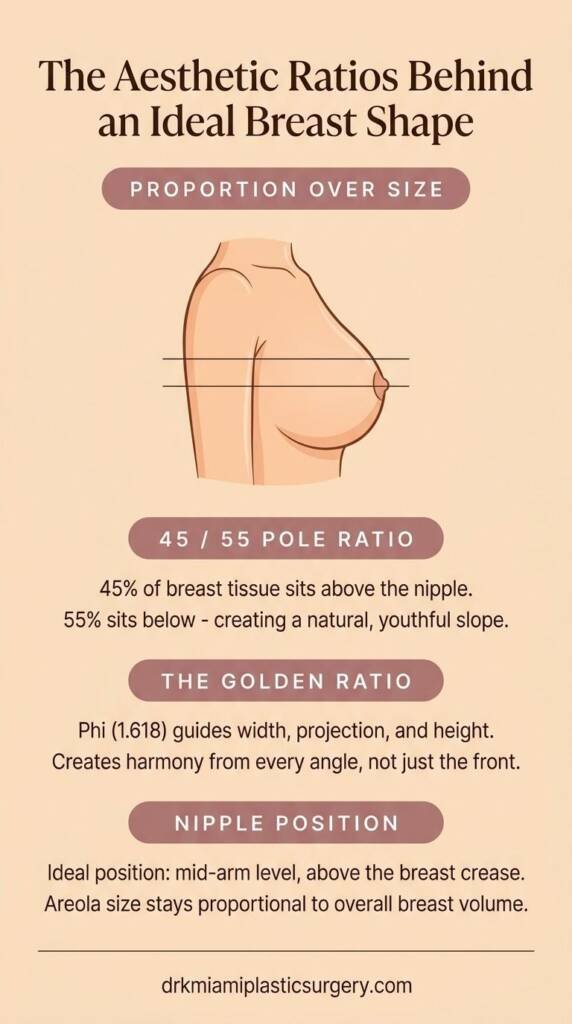
The most researched aesthetic benchmark divides the breast into upper and lower poles. The “upper pole” refers to breast tissue above the nipple, while the “lower pole” is the tissue below.
Studies indicate that the ideal aesthetic breast has 45% of its tissue above the nipple and 55% below it. This ratio creates a natural, youthful slope — fuller at the bottom with a gentle curve at the top.
The golden ratio in breast aesthetics
The golden ratio (phi, approximately 1.618) appears throughout nature and art as a marker of visual harmony. In breast aesthetics, this mathematical relationship applies to the proportions between width, projection, and height.
Surgeons use these principles to create results that look balanced from multiple angles, not just from the front.
Nipple position and areola proportion
Ideal nipple position typically falls at mid-arm level and above the inframammary fold, which is the crease beneath the breast. This placement creates a youthful, lifted appearance.
Areola diameter — the colored area surrounding the nipple — ideally remains proportional to overall breast size. Overly large or small areolas can disrupt visual harmony, which is why some procedures include areola adjustment.
What research says men and women find ideal
Survey data consistently shows that both men and women prefer moderate, proportional breast sizes over extremes. Cultural ideals shift with media trends and celebrity influence — a study of 18,541 women across 40 nations showed wide variation in preferences — so what was considered ideal in the 1990s differs from today’s preferences.
The most important finding from research? Women who choose sizes based on their own anatomy and preferences — rather than external opinions — report higher satisfaction rates. Personal satisfaction matters more than trying to match someone else’s idea of attractive.
How to find your personal ideal breast size
Determining your ideal size requires professional guidance combined with your personal preferences. The following steps help you visualize and communicate your goals effectively.
1. Measure your chest width and ribcage
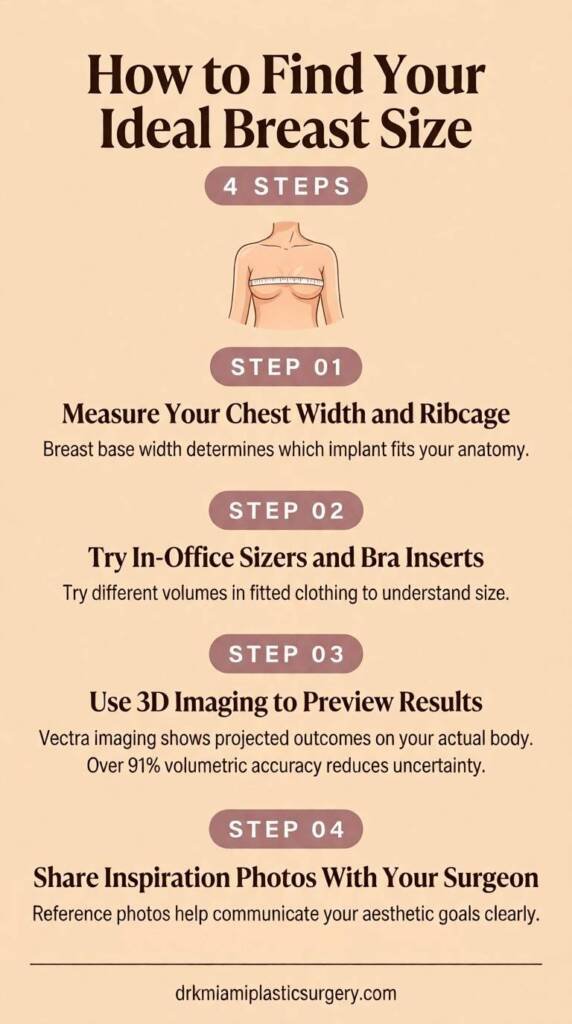
Your surgeon will measure your breast base width during consultation. This measurement determines which implant dimensions will fit your anatomy without extending beyond your natural breast footprint.
Understanding this limitation helps set realistic expectations before you begin exploring sizes.
2. Try in-office sizers and bra inserts
Many women find the “rice test” helpful at home — filling a stocking with measured rice to simulate different volumes inside a sports bra. Professional sizers at consultation provide more accurate visualization.
Trying different volumes in fitted clothing helps you understand how various sizes will look in your daily wardrobe.
3. Use 3D imaging to preview results
Modern simulation technology, like Vectra imaging, shows projected outcomes on your actual body scan with over 91% volumetric accuracy. You can see how different implant sizes and profiles will look from multiple angles.
This technology significantly reduces uncertainty and helps align expectations between you and your surgeon.
4. Share inspiration photos with your surgeon
Bringing reference photos to your consultation helps communicate your aesthetic goals. Keep in mind, however, that what works on another body may look different on yours due to differences in frame and existing tissue.
Open communication about what you like — and don’t like — in reference photos helps your surgeon understand your vision clearly.
Common myths about the perfect breast size
Misconceptions about breast size can lead to unrealistic expectations or choices that don’t serve your long-term satisfaction.
Bigger breasts are always more attractive
Research consistently contradicts this assumption. Proportional sizes are preferred over extremes in virtually every survey. Beyond aesthetics, oversized implants can cause chronic back pain, neck strain, and shoulder discomfort.
Larger implants also carry higher risks of complications like capsular contracture (scar tissue hardening around the implant) and may require earlier replacement.
Cup size looks the same on every body
A “C cup” varies dramatically based on band size, tissue distribution, and frame. A 32C contains significantly less volume than a 38C, even though both are labeled the same cup size. Two women wearing the same cup size can look completely different.
This is why surgeons discuss implant volume in cubic centimeters (cc) rather than cup sizes — it’s a more precise measurement that accounts for individual anatomy.
Celebrity breast sizes suit every frame
Copying a celebrity’s reported size without considering your own anatomy often leads to disappointment. Different heights, ribcages, and proportions require different volumes to achieve similar visual results.
Your surgeon can help translate inspiration photos into realistic goals for your specific body, taking into account the differences between your frame and the reference image.
Cost of breast augmentation in Miami
Breast augmentation in Miami typically ranges from $6,000 to $12,000, depending on several factors.
- Surgeon expertise and credentials: Board-certified plastic surgeons with specialized training typically charge more, reflecting their experience and outcomes
- Facility fees and accreditation: Accredited surgical facilities ensure safety standards but add to overall cost
- Implant type: Silicone implants cost more than saline; shaped (anatomical) implants cost more than round
- Anesthesia and post-operative care: General anesthesia and follow-up appointments factor into total investment
The cost of breast augmentation varies by region, and Dr. K Miami Plastic Surgery offers transparent pricing during consultation so you understand the full investment before making your decision.
Alternatives to breast augmentation for your ideal look
Implants aren’t the only path to your aesthetic goals. Several alternatives address different concerns and preferences.
Fat transfer breast augmentation
This fat transfer breast augmentation procedure uses liposuction to harvest fat from areas like the abdomen or thighs, then injects purified fat into the breasts. Results feel natural and offer the dual benefit of contouring the donor site.
Fat transfer typically provides modest size increases — usually one cup size or less — making it a good option for women wanting subtle enhancement without implants.
Breast lift without implants
Mastopexy (breast lift) addresses sagging and repositions nipples without adding volume. This procedure works well for women experiencing changes from pregnancy, breastfeeding, weight loss, or aging.
A lift can dramatically improve breast shape and position even without increasing size, though some women opt for a breast lift with augmentation to address both sagging and volume loss simultaneously.
Non-surgical shaping options
Supportive garments and professional bra fitting can improve appearance without any procedure. While these options don’t permanently change size or shape, they offer immediate results with no recovery time.
For some women, proper fitting alone creates the silhouette they’re seeking — at least as a starting point before considering surgical options.
Personalize your ideal breast size with Dr. K Miami Plastic Surgery
Finding your ideal breast size is a collaborative process. Dr. Bart Kachniarz takes time to evaluate your unique frame, discuss your aesthetic goals, and use advanced 3D imaging to preview potential results.
The focus is always on natural, proportional outcomes tailored specifically to you. From your first consultation through final follow-up, you’ll have guidance at every step of the process.
Schedule your consultation to begin your personalized journey with confidence.
FAQs about the ideal breast size
What are Ozempic breasts?
“Ozempic breasts” refers to breast deflation or sagging that can occur after significant weight loss, including from GLP-1 medications like Ozempic or Wegovy. Rapid loss of fat tissue can leave excess skin and reduced breast volume, often prompting women to consider augmentation or lift procedures to restore fullness.
Is 34C considered an ideal breast size?
There is no universally ideal cup size. A 34C may appear proportional on some frames while looking too large or small on others, depending on ribcage width, height, and body type. The “ideal” is whatever creates balance with your specific anatomy rather than a particular letter or number.
Is 32DD considered large breasts?
Cup size is relative to band size, so a 32DD on a petite frame may appear moderate rather than large because the band size indicates a smaller ribcage. The visual impact depends entirely on overall body proportions and how the breast volume relates to the rest of your frame.
Does ideal breast size change with age?
Yes, breast tissue naturally changes over time due to hormonal shifts, pregnancy, breastfeeding, weight fluctuation, and gravity. Your ideal size or shape preferences may evolve throughout life, and procedures can be adjusted accordingly to match your goals at different stages.